Unplanned downtime costs have roughly doubled since 2019, and San Diego's manufacturing sector concentrated in aerospace, defense, medical device, and semiconductor production where a stalled line often means a missed delivery on a contract with real penalty clauses attached feels that pressure more acutely than industries with more forgiving production schedules. The good news is that reducing downtime in 2026 doesn't require a single, sweeping automation overhaul. It requires a layered sensor strategy that matches the right monitoring approach to the right equipment, deployed in a sensible sequence rather than all at once.
The most common mistake in downtime-reduction projects is trying to instrument an entire facility simultaneously. A more effective approach ranks equipment by a combination of failure probability and the cost of a stoppage for a San Diego contract manufacturer, that calculation should explicitly include contractual delivery penalties and customer relationship risk, not just the direct cost of the repair itself. The resulting short list, typically the handful of assets responsible for the most historical downtime cost, is where sensor investment should concentrate first, with expansion happening only after that initial deployment proves its value.
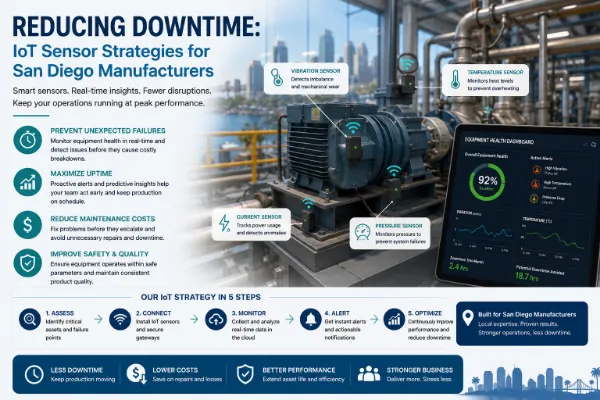
A well-designed downtime-reduction sensor strategy typically layers several distinct monitoring approaches, each catching a different category of developing failure:
- Vibration monitoring on rotating equipment motors, pumps, compressors, spindles remains the workhorse of predictive maintenance, since bearing wear, misalignment, and imbalance all produce distinctive vibration signatures well before a functional failure occurs.
- Thermal and current monitoring catches a different failure class: electrical connection degradation, motor winding issues, and developing friction that vibration sensors alone can miss, particularly relevant for the CNC machining and precision equipment common across San Diego's aerospace and medical device suppliers.
- Acoustic monitoring for compressed air and steam systems detects leaks that quietly waste energy and, in some cases, indicate developing mechanical issues, without requiring the kind of intrusive access vibration sensors sometimes need.
- Power quality and consumption monitoring at the circuit level surfaces equipment drawing more current than its normal operating baseline often an early signal of mechanical strain well before it manifests as an audible or visible problem.
- Overall Equipment Effectiveness (OEE) tracking, pulling data from PLCs and machine controllers already present on most modern equipment, ties all of the above together into a single, comparable performance metric across a production line, making it possible to see which specific losses availability, performance, or quality are actually driving downtime on a given asset.
The point of layering these approaches isn't redundancy for its own sake different failure modes genuinely produce different signals, and a strategy relying on a single sensor type will reliably miss whole categories of developing problems that a different sensor type would have caught early.
A meaningful share of San Diego's manufacturing equipment, particularly in the region's legacy defense and precision machining sector, predates modern connectivity by decades. The practical path for this equipment is retrofit, not replacement: wireless vibration and current sensors that mount externally without disturbing existing control logic, combined with protocol gateways that extract data from older PLCs over their native serial connections and republish it in modern, analyzable formats. The cost of this kind of instrumentation has fallen substantially in recent years a wireless retrofit sensor commonly runs a fraction of what a comparable wired installation cost even a few years ago, largely because it eliminates the cabling labor that used to dominate retrofit project budgets. This matters specifically for San Diego's manufacturing base because so much of it consists of exactly this kind of mixed, multi-generation equipment environment rather than a clean, uniformly modern facility.
Simply detecting a developing problem is only half the value; what happens next determines whether that detection actually prevents downtime. The more mature 2026 approach pairs sensor data with automated workflow a detected anomaly doesn't just generate an alert, it triggers a work order, checks spare parts availability, and proposes a maintenance window aligned with the production schedule rather than requiring a human to manually coordinate each of those steps after the fact. For San Diego manufacturers running tight production schedules against contractual delivery dates, this automation matters as much as the underlying detection accuracy a correctly predicted failure that still takes days to translate into a scheduled repair captures only part of the available benefit.
A practical architectural decision every San Diego manufacturer runs into is where sensor data actually gets processed. Sending every vibration reading to the cloud for analysis is increasingly viewed as unnecessary and costly for time-sensitive anomaly detection edge processing, where a local gateway or controller handles the initial analysis and only forwards meaningful events or summarized data upstream, delivers faster response times and reduces ongoing data transmission costs. Cloud processing still has a clear role, particularly for cross-facility benchmarking and longer-term trend analysis that benefits from aggregating data across multiple sites or comparing a specific asset's behavior against a broader fleet. Most well-designed 2026 deployments use both: edge processing for real-time detection and alerting, cloud aggregation for the kind of longer-horizon analysis that improves the underlying models over time.
One practical consideration worth resolving before signing a sensor platform contract: who owns the historical sensor and maintenance data if a San Diego manufacturer later switches vendors or brings monitoring in-house. Some platforms make historical data easy to export in standard formats; others effectively lock years of accumulated equipment history inside a proprietary system that's costly and disruptive to migrate away from. Given that the real value of a downtime-reduction program compounds over years as models learn a facility's specific equipment behavior, confirming data portability upfront protects that accumulated value rather than leaving it hostage to a single vendor relationship.
| Metric | Typical Improvement With a Layered Sensor Strategy |
|---|
| Unplanned downtime | 30% – 50% reduction |
| Overall maintenance costs | ~25% reduction |
| Equipment uptime | 10% – 20% improvement |
| Asset useful life | 20% – 30% extension |
These figures describe mature, well-instrumented programs a rushed, broadly scoped deployment with noisy sensor data and no clear escalation process will fall well short. Most manufacturers following a disciplined, phased rollout report reaching breakeven on the initial investment somewhere between six and fourteen months, with the majority of projected savings realized within the first year.
One factor that consistently shapes how well these programs run locally is San Diego's labor market. The same skilled maintenance technicians and controls engineers a manufacturing plant needs to design and run a sensor strategy are also being recruited by the region's biotech, aerospace, and defense employers, all competing for a limited local talent pool. Manufacturers who identify and develop an internal champion for a downtime-reduction program early someone who can own sensor calibration, alert triage, and vendor relationships as the program matures tend to sustain momentum better than those relying entirely on outside contractors, who typically aren't available for the kind of ongoing, day-to-day tuning a mature program requires.
Frequently asked questions
Rank assets by a combination of failure probability and stoppage cost including contractual delivery penalties where relevant and start with the handful of assets responsible for the most historical downtime cost, rather than attempting facility-wide coverage at once.
No. Wireless retrofit sensors and protocol gateways can extract useful data from most legacy equipment without replacing it or disturbing existing control logic, which is especially relevant given how much of San Diego's manufacturing equipment predates modern connectivity.
No. Different failure modes produce different signals thermal, acoustic, and power-quality monitoring each catch developing problems vibration sensors alone would miss, which is why a layered approach outperforms any single sensor type.
Well-scoped programs commonly reach breakeven between six and fourteen months, with most of the projected savings realized within the first year of a disciplined, phased deployment.
Predictive systems detect a developing problem and generate an alert. Prescriptive systems go further, automatically generating a work order, checking parts availability, and proposing a maintenance window capturing more of the available downtime reduction than detection alone.
San Diego's skilled maintenance and controls technician labor pool is in direct competition with the region's biotech, aerospace, and defense employers, making it harder to staff and sustain the internal expertise a mature sensor program requires.
Related articles

 Manufacturing IoT