Customers in aerospace, defense, and medical devices, three of San Diego's most significant manufacturing sectors, are demanding digital traceability that can't be faked. That single sentence captures the shift happening on San Diego factory floors right now. As global supply chain disruptions push more production back onto US soil, and as San Diego's manufacturers compete for contracts that increasingly require documented, verifiable quality records rather than a paper checklist and a signature, IoT-connected quality control and traceability systems have moved from a nice-to-have efficiency upgrade to a genuine competitive requirement.
San Diego's manufacturing sector skews toward exactly the industries where traceability failures carry the highest consequences. A defective component that makes it into an aerospace assembly or a medical device isn't just a quality issue, it's potentially a safety and liability issue with regulatory reporting requirements attached. That reality has always shaped how these sectors approach quality control, but the tools available for meeting that bar have changed substantially.
At the same time, San Diego manufacturers are competing in a labor-constrained market. The region's cost of living puts real pressure on manufacturers trying to staff production floors, and the industry-wide skilled trades labor shortage means fewer technicians are available to manage the manual inspection and documentation processes that traceability has historically relied on. IoT-connected quality systems address both pressures simultaneously: they improve traceability rigor while reducing the manual labor burden on an already stretched workforce.
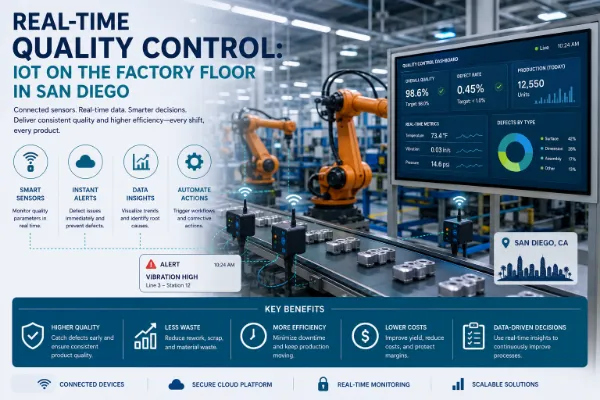
Rather than relying on end-of-line inspection, where a defect is caught only after a part has already moved through several production stages, connected quality systems embed monitoring throughout the process:
- In-line sensors and machine vision checking dimensional accuracy, surface finish, and assembly correctness at each production stage, flagging deviations immediately rather than after a batch is complete.
- Automated data capture tied to specific serial numbers or lot codes, creating a continuous digital record that follows each part or batch through the entire production process, from raw material receipt to final shipment.
- Environmental monitoring for temperature, humidity, and particulate levels in controlled manufacturing environments, particularly relevant for San Diego's medical device cleanrooms where environmental excursions can compromise product integrity.
- Integration with enterprise quality management systems, so sensor-captured data flows directly into the documentation required for regulatory submissions and customer audits, rather than requiring manual transcription that introduces both delay and error risk.
The shift from periodic, manual inspection to continuous, automated monitoring doesn't just catch more defects, it catches them earlier in the process, when the cost of correction is dramatically lower than after a defective part has moved downstream or shipped.
For San Diego manufacturers, the return on investment for connected quality and traceability systems spans several distinct categories.
- Faster, cleaner audits. Customers and regulators increasingly expect digital, on-demand traceability records rather than paper files that take days to compile. Manufacturers who can produce a complete, verifiable production history in minutes have a real advantage when bidding for contracts with strict quality documentation requirements.
- Reduced scrap and rework costs. Catching a dimensional or process deviation in real time, rather than discovering it during final inspection or after a customer complaint, dramatically reduces the cost of correction. Industry data consistently shows defect correction costs multiply the later they're caught in the production sequence.
- Contract eligibility. A growing share of aerospace, defense, and medical device contracts specify digital traceability requirements as a condition of doing business, meaning manufacturers without this capability may simply be ineligible to bid regardless of their production quality.
- Reduced liability exposure. In the event of a product recall or field failure investigation, a complete digital production record narrows the scope of affected units far more precisely than paper documentation, potentially the difference between a targeted recall and a much broader, costlier one.
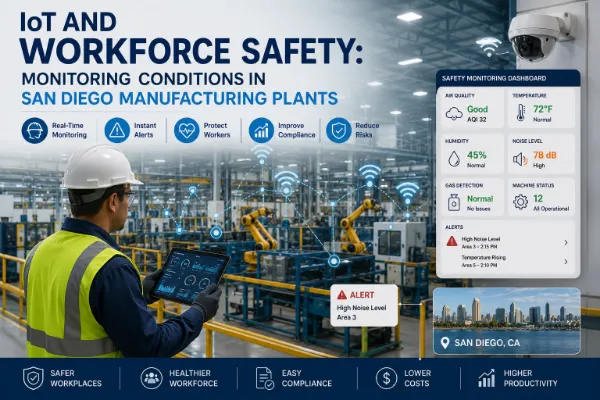
Quality and traceability tend to dominate the conversation, but connected sensors are equally valuable for workforce safety, a real concern for San Diego manufacturers given ongoing skilled labor shortages that make every workplace injury and the associated downtime disproportionately costly.
- Wearable proximity sensors around heavy machinery, alerting workers and halting equipment automatically when someone enters a hazard zone.
- Environmental monitoring for air quality and chemical exposure, particularly relevant in manufacturing processes involving solvents, coatings, or specialized materials common in aerospace and medical device production.
- Ergonomic and repetitive strain monitoring, using wearable sensors to flag movement patterns associated with elevated injury risk before a worker develops a chronic issue.
For a labor-constrained manufacturer, protecting the workforce already on the floor is as much a business continuity issue as it is a safety obligation.
- Map your highest-risk quality control points first. Rather than instrumenting an entire production line at once, identify the specific stages where defects are most costly or most frequently missed by current inspection methods.
- Establish digital serial or lot tracking before adding in-line sensing. Traceability value depends on being able to connect a quality event to a specific unit or batch, which requires reliable identification infrastructure as a foundation.
- Integrate sensor data with your existing quality management system rather than running it in a parallel, disconnected dashboard, since the documentation value depends on that integration.
- Pilot workforce safety sensors on the highest-risk production areas, involving floor workers in the rollout to build trust and address concerns about monitoring early.
- Expand coverage incrementally, using the data and cost savings from the initial deployment to justify further investment across additional production lines.
Legacy equipment integration. Many San Diego manufacturers operate a mix of newer automated equipment and older machinery that predates any connectivity consideration. Retrofitting sensors onto legacy production lines requires careful planning around mounting, power, and network access that a greenfield facility wouldn't face.
Workforce buy-in for safety monitoring. Workers can be understandably wary of sensors they perceive as surveillance rather than protection. Manufacturers who frame the deployment clearly around safety outcomes, and involve floor staff and union representation where applicable in the rollout process, see significantly better adoption than those who implement top-down without explanation.
Data volume and system integration. Real-time quality sensors generate substantial data volume, and without proper integration into existing manufacturing execution and quality management systems, that data becomes noise rather than an asset. This integration work is often underestimated in initial project planning.
Validating new systems in regulated environments. For San Diego's medical device manufacturers operating under FDA quality system requirements, any new monitoring or data capture system introduced into the production environment typically requires its own validation process, which adds time and cost that manufacturers should build into their implementation timeline from the start.
The direction for San Diego's manufacturing sector points toward tighter integration between quality, traceability, and predictive process control. Rather than simply flagging a defect after it occurs, emerging systems increasingly use process data to predict when a production parameter is drifting toward an out-of-specification condition, allowing intervention before a defect is produced at all. As reshoring continues to bring production back to US facilities, and as San Diego's aerospace, defense, and medical device customers continue raising their documentation and traceability expectations, manufacturers who have already built this connected infrastructure will be positioned to win contracts that manufacturers still relying on manual processes simply won't qualify for.
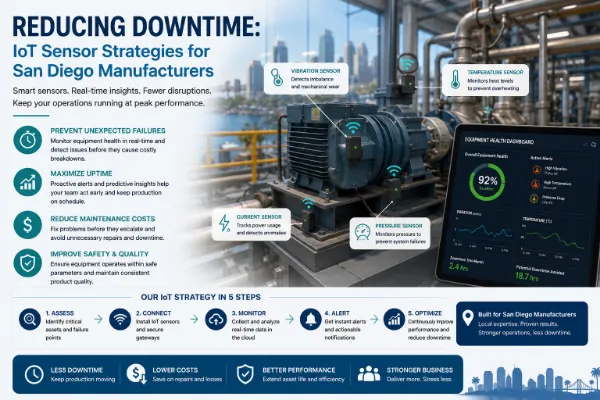
For related coverage, see our guide to real-time quality control IoT for San Diego factory floors, our breakdown of sensor strategies for reducing downtime among San Diego manufacturers, and our overview of IoT workforce safety technology for San Diego manufacturing plants. Explore more coverage in our Manufacturing IoT category or the San Diego manufacturing IoT hub.
Frequently asked questions
Both sectors require detailed production records tied to specific units or batches, but the specific regulatory frameworks differ, aerospace traceability is typically driven by contract and industry quality standards, while medical device traceability falls under FDA quality system regulations. IoT-connected systems can support both, but the documentation and validation requirements differ enough that manufacturers serving both sectors often need configurable systems.
Returns depend heavily on current scrap and rework rates, but manufacturers with meaningful existing defect rates commonly see measurable reductions within the first few months of deployment on a pilot production line, as catching issues earlier in the process reduces the cost of correction significantly compared to end-of-line inspection.
Requirements vary depending on whether a facility is unionized and the specific type of monitoring involved. Manufacturers implementing wearable or environmental monitoring should consult with legal counsel and, where applicable, engage union representation early in the process to ensure compliance with applicable labor agreements and privacy expectations.
Sensor and machine vision costs have decreased substantially, making pilot deployments on a single production line financially accessible for smaller manufacturers. Many mid-size San Diego manufacturers start with a targeted deployment on their highest-value or highest-risk product line rather than a facility-wide rollout.
A complete digital production record allows manufacturers to precisely identify which specific units or batches were affected by a given process deviation or material lot, narrowing the scope of a recall to only the genuinely affected units rather than requiring a broader, more costly recall based on incomplete paper records.
Most manufacturers run a transition period where digital and paper records coexist while the new system is validated, particularly in regulated environments like medical device manufacturing. Over time, the digital system typically becomes the system of record, though some regulatory frameworks still require certain physical documentation to be retained.
Related articles

 Manufacturing IoT