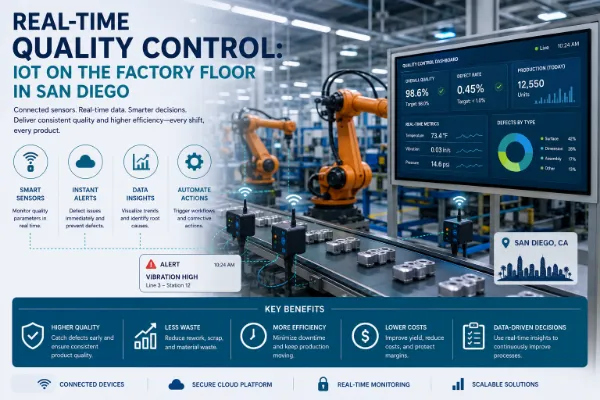
San Diego's manufacturing base isn't built around high-volume commodity production it's built around precision. More than 4,400 manufacturing establishments across the county support work in medical devices, semiconductor lithography, aerospace and defense components, and genomic sequencing hardware, sectors where a defect isn't just a quality metric, it's a certification, safety, or clinical risk. That context matters for understanding why real-time, IoT-connected quality control has moved from an efficiency upgrade to something closer to a baseline expectation across a meaningful share of San Diego's manufacturing sector.
The numbers behind human visual inspection are worth sitting with before evaluating any technology investment. Under real production conditions, human inspectors miss an estimated 20% to 30% of defects, and that accuracy degrades further by 15% to 25% after roughly two hours of continuous observation, a predictable consequence of fatigue that no amount of training fully overcomes. Perhaps more striking: agreement between different inspectors on how severe a given defect actually is runs only 55% to 70%, meaning the same physical part can pass or fail depending on which inspector reviews it and on which shift. For a San Diego medical device manufacturer working under FDA quality system requirements, or an aerospace supplier working to AS9100 and customer-specific inspection standards, that kind of inconsistency isn't just an efficiency problem it's a genuine compliance and liability exposure.
Modern AI-powered visual inspection systems, combining high-resolution cameras, specialized lighting, and deep learning models trained on labeled defect data, now achieve detection accuracy in the 95% to 99% range consistently across every shift, without the fatigue-driven degradation human inspectors experience. In controlled comparative studies, AI systems have detected meaningfully more critical defects than expert human inspectors working under optimal conditions not trainees, experienced inspectors doing exactly the work they were trained for. The systems can also process parts fast enough to keep pace with genuine production speeds, commonly inspecting thousands of parts per hour at sub-100-millisecond inference times per part, which matters enormously for high-throughput lines where a manual inspection station would otherwise become the production bottleneck.
For San Diego's precision manufacturing sector specifically, a few applications show up repeatedly:
- Semiconductor and electronics inspection: Detecting micron-level defects on wafers, PCBs, and microchip assemblies during production exactly the kind of scale problem where the region's chip and lithography manufacturing presence makes this technology directly relevant, not theoretical.
- Medical device surface and dimensional inspection: Scratches, dimensional deviations, and assembly completeness checks on precision components, where a missed defect carries downstream clinical risk, not just a warranty claim.
- Aerospace component and weld inspection: Surface defects, porosity, and structural anomalies on machined and welded parts, where inspection failures have historically been one of the more labor-intensive, bottleneck-prone steps in aerospace supply chains.
A frequently underappreciated benefit of IoT-connected quality inspection, particularly relevant to San Diego's regulated manufacturing sectors, is automatic, audit-ready documentation. Every inspection result can be timestamped, image-archived, and linked to the specific machine state, material batch, and process parameters active at that moment generating exactly the kind of traceable record that ISO 9001, AS9100, IATF 16949, and FDA 21 CFR Part 11 requirements expect, without requiring a quality technician to manually compile that documentation after the fact. For a San Diego medical device or aerospace supplier facing a customer audit or FDA inspection, being able to pull a complete, defensible inspection history for any specific part or batch in minutes rather than days is a real operational advantage that goes well beyond the direct quality benefit.
Industry-wide, the cost of poor quality scrap, rework, warranty claims, and inspection overhead combined averages around 20% of total revenue for a manufacturing operation, a genuinely large number that tends to be underappreciated internally because it's spread across several different budget lines rather than showing up as one obvious expense. AI vision inspection is consistently cited as one of the higher-confidence Industry 4.0 investments specifically because the ROI case is unusually easy to quantify: current cost of poor quality, minus projected improvement from better detection, minus deployment cost, produces a fairly concrete business case rather than a speculative efficiency argument. Documented deployments report defect reductions in the range of 37%, alongside significant reductions in customer complaints tied to escaped defects.
Vision inspection rarely operates in isolation on a well-instrumented San Diego factory floor. It's increasingly paired with the same process and equipment condition sensors driving predictive maintenance programs correlating a specific defect pattern with a specific machine's vibration signature or a specific material batch, for instance, turns an isolated quality alert into genuine root-cause insight. This kind of integration is where a facility's broader IIoT investment and its quality control investment start to reinforce each other, rather than operating as two disconnected systems collecting two disconnected data streams.
Given the gap between vision AI's theoretical capability and its 77% industry-wide pilot failure rate, San Diego manufacturers evaluating vendors should push past accuracy claims and ask concrete deployment questions. How many labeled defect images does the vendor need from your specific parts before the model reaches production-reliable accuracy, and who's responsible for gathering and labeling that data? Does the system run at the edge, on the production line itself, or does it depend on a cloud round-trip that could introduce latency a high-speed line can't tolerate? And critically, does the vendor have documented experience with your specific regulatory environment AS9100 for aerospace suppliers, ISO 13485 for medical device manufacturers or is their track record built entirely in less-regulated industries where the compliance documentation stakes are lower? A vendor who can't answer these specifically is often selling a general-purpose vision platform rather than one genuinely suited to the precision, highly regulated work that defines much of San Diego's manufacturing base.
It's worth being honest that a meaningful share of AI quality inspection pilots commonly cited around three-quarters never make it past the prototype stage industry-wide. The technology itself works; the harder problem is deployment discipline. Common failure points include treating AI vision as a drop-in replacement for an existing manual station without redesigning the surrounding workflow, underestimating the labeled training data needed to reach reliable accuracy on a facility's specific defect types, and skipping the integration work needed to connect inspection results back into existing quality management and MES systems. San Diego manufacturers evaluating this technology should treat those integration and change-management questions with at least as much scrutiny as the vendor's headline accuracy claims.
Introducing AI vision inspection understandably raises questions among existing quality inspection staff about job security, and it's worth addressing that directly rather than avoiding it. In practice, most San Diego manufacturers deploying this technology don't eliminate their quality teams they shift experienced inspectors toward root-cause analysis, supplier quality investigation, and reviewing the ambiguous edge cases an AI system flags but can't confidently classify on its own. That shift generally requires some retraining investment, but it also tends to make the quality role more analytically engaging than the repetitive, fatigue-prone work of hour-after-hour visual scanning, which is worth communicating clearly during rollout to avoid unnecessary resistance from the team whose cooperation the deployment actually depends on.
Frequently asked questions
AI systems commonly achieve 95% to 99% detection accuracy consistently across every shift, compared to human inspection accuracy that runs 70% to 80% under real production conditions and degrades further with fatigue over a shift.
San Diego's manufacturing base is concentrated in precision sectors medical devices, semiconductors, aerospace components where defects carry certification, safety, or clinical risk, making consistent, well-documented inspection considerably more consequential than in high-volume commodity manufacturing.
Yes. Automatically timestamped and archived inspection records tied to specific machine states and material batches support ISO 9001, AS9100, IATF 16949, and FDA 21 CFR Part 11 documentation requirements far more efficiently than manual record-keeping.
Given the direct relationship between defect detection improvement and cost of poor quality, many manufacturers see measurable financial return within months rather than years, though results depend on baseline defect rates and deployment quality.
Common failure points include inadequate labeled training data for a facility's specific defect types, treating the system as a drop-in replacement without redesigning surrounding workflows, and insufficient integration with existing quality management systems.
Not typically. Most successful deployments use AI vision for consistent, high-speed defect detection while shifting human quality staff toward root-cause investigation, process improvement, and handling the ambiguous edge cases the system flags for review.
Related articles

 Manufacturing IoT