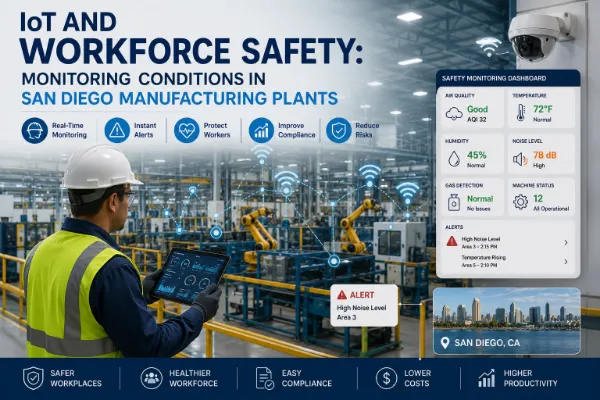
California became the first state in the country to regulate indoor workplace heat specifically, and the rule that took effect in July 2024 remains fully in force for San Diego manufacturers in 2026, with no federal equivalent yet finalized to fall back on or reference. Under California Code of Regulations Title 8, Section 3396, most indoor workplaces including manufacturing plants, warehouses, and distribution facilities must actively measure and document temperature once conditions reach 82°F, with additional requirements kicking in at 87°F or lower for workers wearing heat-restrictive clothing or working in high radiant heat areas. That single regulatory requirement has done more to push IoT-based environmental monitoring into San Diego manufacturing facilities than almost any other single factor, but it's really just the most visible piece of a broader shift toward continuous, sensor-based workforce safety monitoring.
Section 3396 isn't a vague, general safety expectation it specifies concrete obligations. Employers must measure and record temperature and heat index data on an ongoing basis, maintain a written prevention plan, provide accessible cool-down areas, and train employees on heat illness recognition. At 87°F, or at 82°F for workers wearing heat-restrictive protective equipment or working near high radiant heat sources a description that fits a meaningful share of San Diego's manufacturing floor, from foundry and welding operations to certain sterilization and cleanroom processes additional requirements apply, including work-rest schedules and cooling interventions for the work area itself.
The documentation requirement specifically is where continuous IoT monitoring earns its keep. Manual temperature checks, taken periodically with a handheld thermometer, can satisfy a bare minimum reading of the rule, but they reliably miss rapid temperature swings between check intervals and create exactly the kind of documentation gaps that turn into liability during an inspection or, worse, after an actual heat illness incident. Cal/OSHA has shown it will pursue significant penalties for heat illness violations a six-figure citation against an outdoor employer in a recent enforcement action makes clear the agency is willing to impose real financial consequences, not just issue warnings.
For a San Diego manufacturer building out compliance-grade monitoring, the practical deployment typically covers a few connected sensor categories:
- Zone-level temperature and heat index sensors placed throughout production areas, not just at a single central location, since heat distribution across a manufacturing floor is rarely uniform areas near furnaces, ovens, or poorly ventilated corners routinely run hotter than a facility's average reading would suggest.
- Automated threshold alerting that notifies supervisors the moment a zone crosses the 82°F or 87°F triggers, rather than relying on someone noticing conditions have become uncomfortable and manually checking a thermometer.
- Continuous, timestamped data logging that generates the documented record Section 3396 requires automatically, rather than requiring a supervisor to manually record readings on a clipboard throughout a shift.
- Integration with HVAC and ventilation controls where feasible, allowing a facility to automatically trigger cooling interventions in a specific zone rather than requiring manual adjustment after conditions have already become a problem.
Heat compliance tends to be the entry point, but San Diego manufacturers are increasingly extending similar sensor-based monitoring to other workplace safety categories that carry real risk on a modern factory floor:
- Gas and air quality detection, particularly relevant for facilities using solvents, welding operations, or certain semiconductor and electronics manufacturing processes where specific chemical exposure limits apply. Automated docking stations that calibrate and bump-test portable gas detectors have replaced manual checks in more safety-mature facilities, logging compliance data automatically rather than relying on a technician's paper checklist.
- Noise exposure monitoring, using wearable dosimeters that track an individual worker's cumulative noise exposure across a shift rather than relying on a general area noise reading that may not reflect what any specific worker actually experiences as they move between zones.
- Proximity and geofencing alerts around heavy machinery and forklift traffic, flagging when a worker enters a hazardous zone or when equipment and personnel paths are on a collision course a category increasingly common on production floors with significant automated material handling.
- Wearable fatigue and physiological monitoring, increasingly used in physically demanding roles to flag signs of heat stress or fatigue before they progress to a medical event, complementing rather than replacing environmental sensors since two workers in the identical environmental conditions can have very different individual heat tolerance and hydration status.
San Diego's manufacturing sector includes a meaningful share of facilities where these risks concentrate in specific, identifiable ways. Precision machining and metal fabrication shops common in the region's aerospace and defense supply chain involve welding, cutting, and finishing processes with genuine heat, fume, and noise exposure. Cleanroom and sterilization processes in the medical device sector often require protective garments that restrict heat dissipation, which is precisely the scenario the indoor heat rule's lower 82°F threshold is designed to address. And semiconductor and electronics manufacturing frequently involves specific chemical handling with its own exposure monitoring requirements layered on top of the general heat rule. A generic, one-size-fits-all safety monitoring approach tends to underperform in this environment; sensor deployment that's actually mapped to a facility's specific process risks delivers considerably more protective value than uniform coverage applied without that context.
A common concern among San Diego facility safety managers evaluating this technology is alert fatigue a monitoring system generating constant low-priority notifications trains staff to deprioritize alerts generally, undermining the entire point of continuous monitoring. The more effective implementations tier alerts by actual severity and required response, distinguishing a routine "approaching threshold, monitor" notification from a "exceeded threshold, immediate action required" alert that triggers a defined response protocol rather than treating every reading as equally urgent. This tiering work takes more upfront configuration than accepting a vendor's default alert settings, but it's what determines whether a monitoring system actually changes floor behavior or just becomes background noise a safety team learns to tune out.
For workers on a San Diego manufacturing floor covered by this kind of monitoring, it's reasonable to want clarity on a few things: whether environmental sensors are purely aggregate zone readings or tied to individual wearables that track personal data, how long that data is retained, and who has access to it beyond the immediate safety response. Employers rolling out this technology tend to see smoother adoption when they communicate the compliance and protective rationale clearly upfront framing it as "this is what keeps us within Cal/OSHA requirements and catches a problem before it becomes a heat illness incident" rather than introducing new sensors without context, which can understandably read as surveillance rather than protection if the purpose isn't explained.
For a San Diego manufacturer weighing this investment, the clearest framing typically isn't a generic safety culture argument it's regulatory exposure paired with real incident cost. A single significant Cal/OSHA citation, as the enforcement record shows, can run into six figures, and that's before accounting for the cost of a workers' compensation claim, potential litigation, or the operational disruption of an actual heat illness incident on the floor. Framing continuous monitoring as compliance insurance, with the workforce safety and retention benefits as a genuine secondary gain rather than the sole pitch, tends to land more effectively with ownership and finance stakeholders evaluating the upfront cost.
Frequently asked questions
The rule applies once indoor temperatures reach 82°F, with additional requirements including work-rest schedules and cooling interventions applying at 87°F, or at 82°F specifically for workers wearing heat-restrictive protective equipment or working in high radiant heat areas.
It can satisfy a minimum reading of the rule, but manual checks miss rapid temperature changes between readings and create documentation gaps that continuous, automated sensor logging avoids entirely.
Gas and air quality exposure, noise levels via wearable dosimeters, and proximity alerts around heavy machinery are increasingly common extensions of the same sensor-based safety monitoring approach.
Not yet. A federal OSHA heat rule has been proposed but not finalized as of 2026, meaning California's state-specific indoor and outdoor heat rules remain the operative requirement for San Diego employers.
Cal/OSHA has issued citations reaching well into six figures for willful violations of heat illness prevention requirements, underscoring that this is an actively enforced regulation rather than a rarely-cited technicality.
Precision machining and metal fabrication involving welding and finishing processes, and medical device cleanroom operations requiring heat-restrictive protective garments, are among the sectors most likely to trigger the rule's lower compliance thresholds.
Related articles

 Manufacturing IoT