San Diego's commercial real estate market is dealing with two very different pressures at the same time. Office landlords across downtown, Mission Valley, and the UTC corridor are managing elevated vacancy and tenants who expect measurably better building experience as a condition of signing or renewing a lease. Meanwhile, the county's life science landlords, serving the dense biotech cluster in Torrey Pines and Sorrento Valley, are dealing with tenants who need precise, continuously documented environmental control for lab and research operations. Both groups have spent the past several years adding sensors, and both are discovering the same lesson: more sensors don't automatically mean a smarter building. What matters in 2026 is whether that sensor data is fused into decision-grade insight, or whether it's just noise sitting in a dashboard nobody checks.
San Diego office vacancy has remained elevated as return-to-office patterns continue to settle, putting real pressure on landlords to differentiate their buildings beyond location and price. At the same time, San Diego's life science real estate sector, one of the most significant in the country given the region's biotech density, commands premium rents specifically because tenants need buildings capable of supporting precise environmental control, something a standard office building's mechanical systems were never designed to deliver.
Both dynamics point toward the same conclusion: building-level data has become a genuine leasing and retention factor, not just an operational efficiency tool. Landlords who can demonstrate measurable indoor air quality, energy performance, and space utilization data have a real advantage in a market where tenants, particularly larger corporate and life science tenants, are asking harder questions before signing.
Early smart building deployments focused on isolated data points, a single occupancy sensor here, a temperature reading there. The problem with this approach is that isolated readings don't provide context. Knowing a conference room is occupied tells a facility manager very little on its own. Knowing that the room has been occupied for three hours at 40 percent capacity with degrading air quality tells a facility manager exactly what to do.
Sensor fusion, combining multiple data streams to produce a single, decision-grade insight, is the defining shift in San Diego smart building deployments this year. Rather than treating occupancy, air quality, temperature, and equipment performance as separate systems, integrated platforms now correlate them to answer operational questions directly: is this floor over-conditioned relative to actual use, is this space chronically underutilized in a way that should inform a future lease renewal conversation, is equipment degrading in a way that predicts a maintenance issue before it causes a comfort complaint.
For San Diego office landlords, occupancy sensors across conference rooms and open work areas now generate the kind of utilization data that directly informs leasing strategy. A portfolio showing certain floors or buildings consistently underutilized compared to others provides landlords and their tenants with concrete data to inform consolidation, expansion, or renewal decisions, rather than relying on anecdotal impressions of how a space is being used.
For San Diego's Torrey Pines and Sorrento Valley life science landlords, sensor fusion takes on a different, higher-stakes role. Lab tenants often require documented, continuous environmental monitoring, temperature, humidity, and air pressure differentials between spaces, as part of their own regulatory and research integrity requirements. Landlords who can provide this documentation as a built-in building feature, rather than requiring tenants to install their own monitoring, have a genuine competitive advantage in a tight life science leasing market.
Water leak detection has become a standard component of smart building deployments across San Diego property types, with sensors placed in mechanical rooms, under raised floors, and near plumbing fixtures. Given San Diego's high water costs and the significant damage a slow, undetected leak can cause in multi-story buildings, this has become one of the fastest-payback additions landlords are making regardless of building class.
- Energy cost reduction. Sensor-fused HVAC and lighting optimization based on actual occupancy, rather than fixed schedules, commonly reduces energy costs by a substantial margin, directly improving net operating income on properties where landlords bear utility costs.
- Leasing differentiation. In a competitive San Diego office market, documented building performance data, air quality, energy efficiency, tenant experience metrics, increasingly factors into corporate tenant site selection decisions, particularly for larger tenants with sustainability commitments.
- Reduced reactive maintenance costs. Sensor fusion enabling predictive rather than reactive maintenance reduces emergency repair costs and the tenant relationship damage that comes with unexpected building system failures.
- Life science rent premiums. Buildings that can offer built-in, documented environmental monitoring command a real competitive advantage in San Diego's tight life science leasing market, where tenant build-out costs and timelines are directly affected by a building's existing environmental control infrastructure.
- Audit existing sensor infrastructure before adding more. Many San Diego buildings already have isolated sensors installed from previous technology investments. Understanding what data already exists and where the gaps are prevents redundant spending.
- Establish clear data standards before expanding coverage. Buildings that deploy sensors without governance standards, consistent data formats, defined retention policies, clear ownership of monitoring responsibilities, often end up with data nobody trusts enough to act on.
- Prioritize the fusion layer over additional sensor types. A platform that effectively correlates existing occupancy, temperature, and air quality data often delivers more actionable insight than adding an entirely new sensor category without integration.
- Define specific KPIs before deployment, such as indoor air quality time-in-range, reduction in after-hours HVAC runtime, space utilization accuracy, and reduction in reactive maintenance events, so the value of the sensor fusion investment can be measured concretely.
- Extend monitoring into the digital twin where relevant, particularly for larger portfolios or life science buildings, connecting building operations data to the same models used during design and construction for a continuous operational thread.
Sensor sprawl from disconnected past investments. Buildings that have accumulated sensors from multiple technology vendors over several years often struggle with integration, since older systems weren't designed with interoperability in mind. This is one of the most common reasons smart building investments underdeliver on their promised value.
Cybersecurity exposure. As building systems become more connected, they also become more exposed to potential compromise, and facility teams historically focused on mechanical systems don't always have the cybersecurity expertise needed to secure an increasingly networked building. This gap deserves dedicated attention, not an afterthought treatment.
Tenant data privacy in shared buildings. Occupancy and utilization sensors in multi-tenant buildings raise questions about what data is shared with which tenant, and landlords need clear policies distinguishing building-level operational data from anything that could be construed as monitoring a specific tenant's activity.
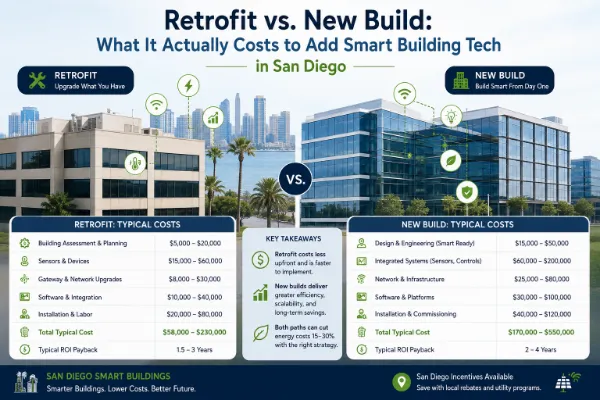
Retrofit costs on older San Diego building stock. Many of San Diego's older office and industrial buildings, particularly in established neighborhoods, weren't designed with the cabling or network infrastructure that modern sensor deployments require. Landlords should scope this infrastructure work as part of any smart building investment rather than assuming existing wiring will suffice.
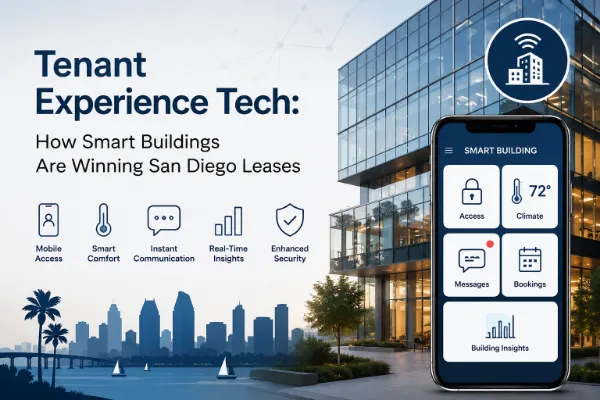
The next stage for San Diego's smart building sector is deeper integration between building operations data and tenant-facing applications, giving occupants direct visibility and even some control over their own space's environmental conditions, rather than keeping all building intelligence locked in a facility management dashboard. For life science landlords specifically, expect continued growth in built-in environmental monitoring as a standard rather than premium building feature, driven by the sustained demand from San Diego's biotech tenant base for lab-ready space with documented environmental control already in place.
For related coverage, see our guide to smart building IoT and energy costs for San Diego office landlords, our comparison of smart building retrofit versus new-build costs, and our overview of how tenant experience technology affects San Diego leasing outcomes. Explore more coverage in our Smart Buildings category or the San Diego smart buildings hub.
Frequently asked questions
Adding more sensors increases the volume of raw data a building generates, while sensor fusion focuses on correlating existing data streams to produce actionable insight. A building can have extensive sensor coverage and still fail to deliver useful information if that data isn't integrated and analyzed together.
Life science buildings typically require more precise, continuously documented environmental monitoring, temperature, humidity, and pressure differentials in particular, to support tenant research and regulatory requirements, whereas standard office buildings focus more heavily on occupancy-driven energy optimization and general comfort monitoring.
Retrofitting is common and often financially justified through energy savings and leasing differentiation, though older buildings may require additional infrastructure investment in cabling and network capacity that newer construction wouldn't need. A retrofit cost assessment should be part of any smart building evaluation for older properties.
This varies by landlord and lease agreement. Many landlords now provide tenants with access to environmental and energy data relevant to their specific space as part of a broader tenant experience offering, though the specifics of what's shared should be clearly defined in the lease or building management policy.
Energy savings from occupancy-based HVAC and lighting optimization are often measurable within the first year of deployment, though the exact timeline and magnitude depend on the building's existing mechanical systems and how significantly actual usage patterns differ from the fixed schedules previously in place.
Building systems should be segmented from general tenant and public-facing networks, with encrypted data transmission and clear device authentication protocols. Landlords should also confirm vendor security practices as part of procurement, since a compromised building system can affect operations across multiple tenants simultaneously.
Related articles

 Smart Buildings