San Diego's office leasing market has spent the last several years sorting itself into two tiers: buildings tenants actively want to be in, and buildings tenants are willing to settle for on price. The dividing line increasingly has less to do with a building's address or its architecture and more to do with what happens once employees actually walk through the door how the space feels, how easily it accommodates a hybrid schedule, and whether the building itself seems to be paying attention to their comfort. A growing share of that experience is now delivered through IoT-connected technology, and landlords who've invested in it are seeing it show up directly in leasing conversations.
Hybrid work didn't just reduce how often people come into San Diego offices it raised the bar for what has to be true on the days they do. A company negotiating a lease renewal in 2026 isn't just asking whether the square footage works; they're asking whether the space will actually pull employees back in from home. That's a harder question to answer with architecture alone, and it's pushed landlords to compete on operational quality in ways that weren't part of typical lease negotiations a decade ago.
This shift shows up clearly in how San Diego commercial construction and renovation projects are being scoped in 2026: flexible floor plans, energy-efficient systems, and scalable infrastructure that supports hybrid work patterns are increasingly treated as standard requirements rather than premium upgrades. Smart building technology sits at the center of that shift because it's what actually makes flexibility, comfort, and convenience measurable and consistent, rather than something a property manager promises verbally during a tour.
The term covers a fairly broad set of systems, and the specific mix that matters varies by tenant type, but the categories that consistently come up in San Diego lease negotiations include:
- Indoor air quality monitoring and reporting: Real-time CO2, particulate, and humidity sensors that let a landlord show not just claim that ventilation meets a defined comfort and health standard. This has become particularly relevant for tenants evaluating alignment with WELL Building or similar occupant health standards during site selection.
- Occupancy-responsive comfort: HVAC and lighting that adjust automatically based on how many people are actually in a space, rather than running a fixed schedule regardless of whether a floor is half-empty on a Friday.
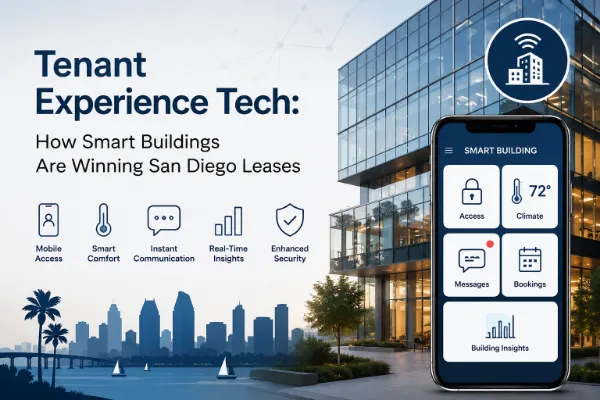
- Mobile access and wayfinding: Smartphone-based building entry, conference room booking, and visitor management that removes friction from the small daily interactions that shape how a space feels to work in.
- Tenant-facing dashboards and apps: Interfaces that let occupants see and sometimes adjust their own zone's temperature, report issues directly, or view building sustainability performance turning building operations from an invisible background function into something tenants can see is working.
- Submetered, transparent utility billing: Accurate, usage-based billing that tenants increasingly expect as a baseline of trust, rather than estimated allocations based on square footage alone.
Property managers and brokers working San Diego's competitive submarkets report that tenant experience technology comes up in negotiations in a few consistent ways. Larger tenants, particularly in life sciences, technology, and professional services, increasingly ask for documentation of a building's environmental performance and indoor air quality monitoring as part of due diligence not as an afterthought, but as a standard question alongside more traditional lease terms.
It also shows up in retention. A tenant that's been in a building for a few years and has grown accustomed to submetered billing accuracy, responsive maintenance triggered by sensor alerts rather than complaint calls, and a mobile app that actually works tends to view relocating as a real cost, not just a hassle the operational quality becomes part of what they'd be giving up. Landlords who've made these investments are using that retention effect explicitly in renewal conversations, framing the building's technology stack as part of the value proposition rather than something tenants take for granted.
Not every tenant experience feature delivers equal value, and San Diego landlords evaluating where to invest are increasingly discerning about it. A few patterns worth noting:
| Feature Category | Typical Impact | Notes |
|---|
| Indoor air quality transparency | High | Directly tied to occupant health perception; increasingly requested in due diligence |
| Occupancy-based comfort control | High | Reduces complaint volume and demonstrably improves comfort consistency |
| Mobile access / app-based entry | Moderate | Valued mainly by younger workforces; less differentiating for some tenant types |
| Novelty features (voice control, gimmick displays) | Low | Rarely factors into lease decisions; can read as style over substance |
The consistent theme is that features tied to measurable comfort, health, and cost transparency tend to influence leasing decisions, while features that are primarily about visual impressiveness tend not to move the needle much once the initial tour is over.
- Communicating performance, not just installing it: A building can have excellent air quality monitoring, but if that data never reaches tenants in an understandable form, it doesn't generate any leasing benefit. The most effective programs pair the underlying technology with regular, plain-language reporting so tenants actually notice the improvement.
- Uneven tenant expectations: A biotech tenant evaluating lab-adjacent space and a small professional services firm often weigh these features very differently, which means a one-size-fits-all technology package doesn't always match what a specific prospective tenant actually values.
- Retrofit disruption: Installing tenant-facing systems in an occupied building requires careful scheduling to avoid disrupting current tenants a poorly coordinated installation can temporarily damage the experience it's meant to improve.
- Data without follow-through: Sensor systems that flag comfort or maintenance issues only deliver a leasing benefit if facilities teams actually act on the alerts quickly. A building that collects the data but responds slowly loses much of the credibility advantage.
Owners evaluating this for the first time don't need to deploy a full tenant-experience stack to see a leasing benefit. A reasonable starting sequence looks like this: begin with indoor air quality and occupancy sensors in common areas and a representative sample of tenant suites, since this is the data prospective tenants ask about most often during due diligence. Pair that with a simple, tenant-facing way to see the resulting performance even a monthly summary email showing ventilation and comfort metrics is more persuasive than an unverified claim on a marketing flyer. Only after that foundation is in place does it typically make sense to layer in mobile access, room booking, or a full tenant app, since those features depend on tenants actually trusting the underlying building performance data first.
Budgeting realistically matters here too. A phased rollout focused on common areas and a handful of pilot floors, rather than a simultaneous building-wide installation, lets facilities teams calibrate sensor placement and response protocols before scaling and gives leasing teams real performance data to point to within a single budget cycle rather than waiting for a multi-year rollout to finish.
The next stage of tenant experience technology in San Diego's office market is less about adding new sensor categories and more about integration and communication connecting building automation, access control, and tenant-facing apps into a single coherent experience rather than a collection of separate systems tenants have to learn individually. Digital twin modeling is also starting to play a role here, letting landlords simulate how a proposed renovation or system change will affect comfort and air quality before committing capital, which reduces the risk of a costly upgrade that doesn't actually deliver the experience improvement tenants were promised.
As San Diego's office market continues to sort into flight-to-quality winners and laggards, tenant experience technology is increasingly one of the clearest, most measurable ways landlords can demonstrate which category their building belongs in not through marketing language, but through data tenants can actually see.
Frequently asked questions
Rather than commanding a large explicit premium on its own, it more commonly functions as a differentiator that helps a building win tenants faster and retain them longer, which supports occupancy and reduces costly downtime between leases.
Indoor air quality data and occupancy-responsive comfort come up most consistently, particularly among life sciences, technology, and professional services tenants evaluating multiple buildings during site selection.
Yes, in most cases. Wireless sensors and mobile access systems typically install during normal business hours without service interruptions, though larger BAS integration projects may require more coordinated scheduling.
No. Smaller buildings can implement a scaled-down version starting with air quality and occupancy monitoring and still see a meaningful leasing benefit, particularly in competitive submarkets where tenants are comparing multiple similarly sized options.
Continuous indoor air quality and environmental monitoring supports the kind of ongoing performance verification these certifications increasingly require, making it easier for landlords to maintain certification status rather than relying on a one-time assessment.
Installing the technology without a clear plan to communicate the resulting performance data to tenants. The systems only generate a leasing advantage if tenants actually see and understand the improvement, not just experience it passively.
Related articles

 Smart Buildings