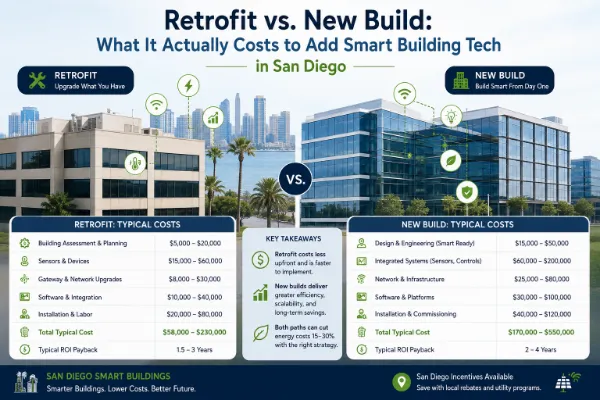
Every San Diego developer and building owner eventually asks some version of the same question: is it worth retrofitting smart technology into an existing property, or should we wait for a ground-up project where it can be designed in from day one? The honest answer is that both paths make sense in different situations, but the cost gap between them is bigger than most people expect going in and the reasons for that gap matter for how you plan either project.
With San Diego's 2026 commercial construction pipeline leaning heavily toward adaptive reuse converting older office, retail, and industrial buildings rather than building new this isn't a hypothetical decision for a lot of local owners. It's the actual choice sitting in front of them on a current project.
The single biggest driver of cost difference between retrofit and new construction isn't the hardware sensors and controllers cost roughly the same whether they're going into a new building or an old one. It's labor and access. Running conduit, mounting sensors, and pulling network drops during construction, before walls and ceilings are closed up, is dramatically cheaper than doing the same work in a finished, occupied building where every cable run means opening a ceiling tile, coordinating with tenants, and often working after hours to avoid disruption.
Industry cost models for 2026 put the smart technology layer in new construction at roughly 8% to 15% of the base building cost a premium that gets absorbed into the overall project budget and financed alongside everything else. Retrofitting equivalent capability into an existing building can run several times higher per unit of functionality once you account for the added labor, tenant coordination, and working around existing infrastructure that wasn't designed to accommodate it.
Not all retrofits are the same scope, and the pricing reflects that. Here's how 2026 project costs generally break down for a typical San Diego commercial building:
| Retrofit Scope | Cost Range (per sq ft) | What It Covers |
|---|
| Wireless sensor overlay, no existing BAS | $0.50 – $1.50 | Occupancy, temperature, and energy sensors on independent wireless networks; no rewiring required |
| BAS integration / gap-filling | $0.25 – $0.75 | Bridging an existing BACnet or LonWorks system to a modern analytics platform |
| Full BAS replacement | $2.50 – $7.50 | New controllers, wiring, and commissioning for buildings with failing legacy systems |
| Deep energy retrofit | $15 – $50+ | Combines smart controls with envelope, HVAC equipment, and renewable integration for major performance gains |
For a 100,000-square-foot San Diego office building, that means a lightweight wireless retrofit might run $50,000 to $150,000, while a full building automation system replacement could reach $750,000 or more before factoring in tenant improvement coordination a wide enough range that getting an accurate scope defined early is worth more than almost anything else in the budgeting process.
New construction avoids nearly all of the friction that drives retrofit costs up. Conduit paths get planned alongside electrical and mechanical drawings. Sensor locations get built into ceiling grids before they're installed. Network infrastructure gets sized for IoT device density from the outset instead of being squeezed into a system designed for office computers and printers a decade or two ago.
This is a big part of why San Diego's active life sciences and biotech construction sector where labs and cleanrooms already demand extensive environmental monitoring tends to build smart infrastructure in as standard practice rather than treating it as an optional add-on. Once you're already running extensive MEP systems for a lab environment, the incremental cost of connecting them to a modern IoT platform is comparatively small.
The tradeoff, of course, is that new construction isn't an option for most existing property owners. It only applies to ground-up development or a gut renovation extensive enough to functionally reset the building's infrastructure.
A few regional factors push San Diego retrofit costs in a particular direction compared to national averages:
- Seismic and structural considerations: Older San Diego buildings undergoing significant retrofit work often trigger structural review requirements, and coordinating IoT infrastructure installation with any required seismic upgrades can either save money through shared mobilization costs or add complexity if the projects aren't sequenced well.
- Title 24 compliance triggers: California's Title 24 energy code updates mean that a retrofit crossing certain thresholds of scope can trigger additional efficiency requirements insulation, lighting controls, HVAC efficiency that weren't part of the original smart building scope but end up bundled into the project anyway.
- Labor market pricing: San Diego's skilled trades market, particularly for low-voltage and controls technicians, has tightened as biotech, defense, and life sciences construction compete for the same specialized labor pool, which affects installation labor costs on both retrofit and new build projects.
- Coastal and climate considerations: Buildings near the coast sometimes require more corrosion-resistant hardware for outdoor or semi-exposed sensor installations, a modest but real cost difference compared to inland deployments.
For most existing San Diego property owners, the decision isn't really retrofit-versus-new-build in the abstract it's whether to bundle smart building technology into work that's already planned. A few practical rules of thumb tend to hold up:
- If a major tenant improvement, HVAC replacement, or gut renovation is already scheduled, that's almost always the cheapest window to add smart infrastructure, since a large share of the labor cost is shared with work that's happening anyway.
- If no major renovation is planned, a phased wireless sensor overlay focused on the highest-value systems energy submetering and HVAC monitoring typically deliver the fastest payback usually makes more financial sense than waiting for a bigger capital project.
- For buildings with a genuinely obsolete or failing BAS, replacing it with a modern system is often worth doing on its own merits for reliability reasons, and building in IoT connectivity at the same time adds relatively little incremental cost.
Sticker price on installation is only part of the budget conversation, and it's a part landlords tend to focus on almost exclusively while underestimating what comes after commissioning. Cloud platform subscriptions, connectivity fees for cellular or LoRaWAN gateways, sensor battery replacement cycles, and periodic recalibration all add up to an ongoing operating cost that should be modeled alongside the upfront capital spend, not treated as an afterthought once the system is live.
For most deployments, ongoing software and connectivity costs run in the range of a few cents to about fifteen cents per square foot annually a modest figure compared to the installation cost, but one that compounds across a large portfolio and should be built into long-term operating budgets rather than discovered a year in. Buildings that skip this planning step sometimes end up with orphaned systems: sensors installed correctly but software subscriptions that lapse, leaving expensive hardware quietly disconnected from any platform that can use its data. Factoring in a maintenance and software line item from day one, rather than treating the retrofit as a single capital event, is one of the more reliable ways to protect the return on either a retrofit or new-build investment over its full useful life.
Wireless sensor technology continues to bring retrofit costs down faster than new-construction costs are falling, simply because wireless installation avoids the labor-intensive wiring work that made older retrofit projects so expensive. Battery life on modern wireless sensors has also extended to five-to-ten-year ranges in many cases, reducing the ongoing maintenance burden that used to make owners hesitant about wireless deployments. The gap between retrofit and new-build costs isn't closing entirely, but it's narrowing enough that more San Diego owners are finding retrofit projects pencil out sooner than they expected.
Frequently asked questions
Per square foot, new construction is almost always cheaper for equivalent capability. Retrofit becomes the practical choice simply because most San Diego property owners are working with existing buildings rather than starting from scratch.
Bundling the smart technology installation with a tenant improvement, HVAC replacement, or other renovation that's already planned typically cuts costs significantly, since labor and access costs are shared across both projects.
Title 24 doesn't specifically mandate IoT sensors, but its updated energy efficiency requirements for lighting controls and mechanical systems often push renovation projects toward automated controls as the most practical way to meet compliance thresholds.
A single-floor deployment focused on energy and occupancy monitoring can start in the $15,000 to $50,000 range, depending on square footage and the number of zones covered.
Not typically for sensor installation itself, but if a retrofit project is extensive enough to trigger a broader building review, seismic or structural requirements may apply separately and should be scoped alongside the technology installation.
Wireless systems are usually the more cost-effective choice for retrofits because they avoid the cabling labor that drives up wired installation costs, though wired systems can still make sense for large new-construction or deep-retrofit projects where conduit is already being run for other reasons.
Related articles

 Smart Buildings