The most important healthcare IoT device may not be the newest wearable. It may be the system that notices when a patient's readings change, understands who needs to see the information and makes sure somebody acts on it.
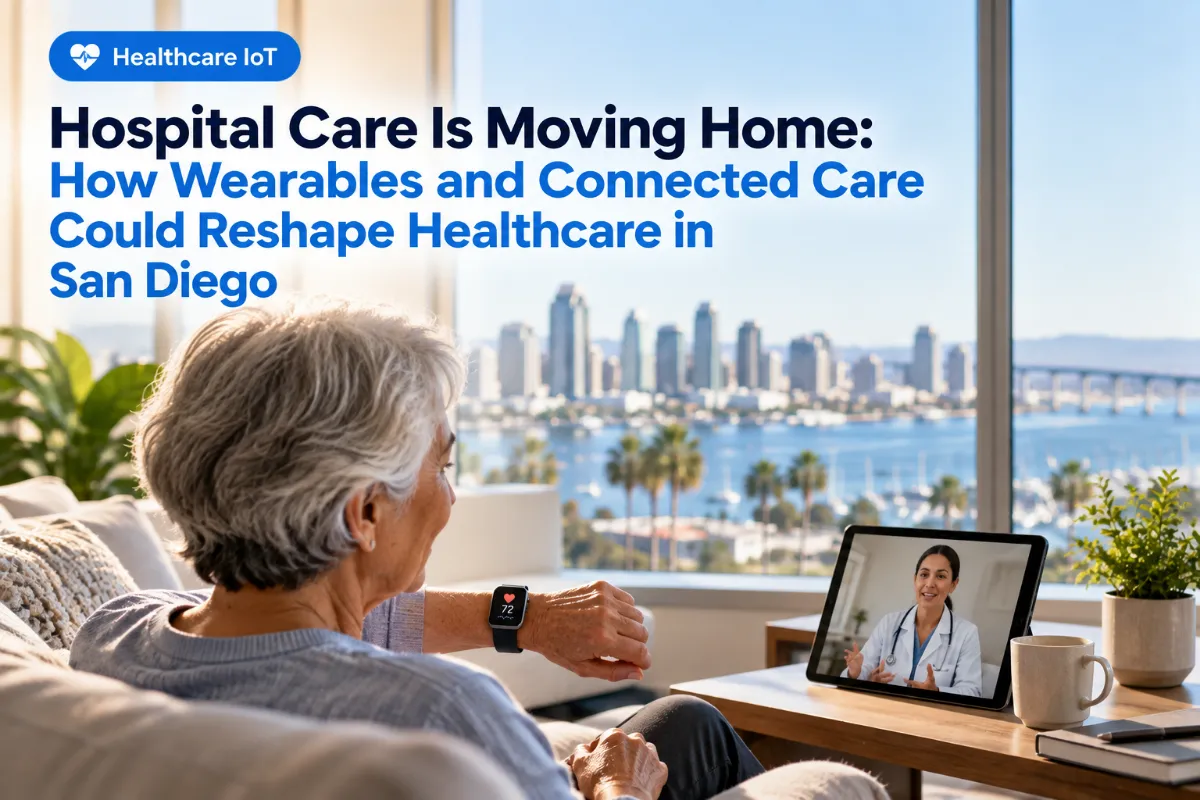
That distinction is increasingly relevant in San Diego as health systems explore virtual care, integrated health data, remote patient monitoring and care delivered at home when appropriate.
Connected health devices can generate useful measurements outside traditional clinical settings. San Diego also has local connected-health companies, including Dexcom and ResMed.
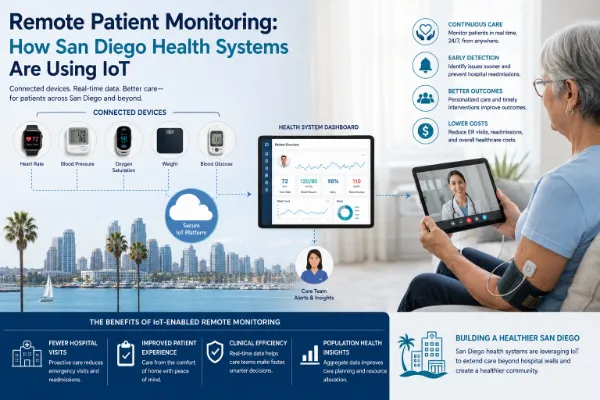
But hardware availability does not automatically create a connected-care system. Our guide to remote patient monitoring in San Diego health systems examines the monitoring layer.
Who reviews incoming data? How quickly? What threshold creates an alert? Does the trend matter more than one reading? Does the clinician see remote information alongside the rest of the patient's record? These workflow questions determine whether healthcare IoT becomes useful.
| Layer | Role | Failure to Avoid |
|---|
| Patient device | Capture measurements | Difficult-to-use equipment |
| Connectivity | Move information securely | Missing data without visibility |
| Data platform | Organize readings | Another isolated dashboard |
| Clinical rules | Identify important information | Too many low-value alerts |
| Care workflow | Review and respond | No clear ownership |
Hospital capacity is expensive and finite. For appropriately selected patients, connected care can provide additional visibility while recovery or monitoring occurs outside a hospital.
Our article on Hospital-at-Home and remote patient monitoring in San Diego examines this capacity argument.
If a device generates thousands of measurements but the care team cannot distinguish normal variation from meaningful deterioration, more data can increase workload without improving care.
- What change is the program trying to detect?
- How quickly does it require a response?
- Which measurements are informative?
- Who reviews them?
- What action follows an alert?
Programs should track alert volume, how many alerts lead to action, how quickly they are reviewed and whether thresholds need adjustment for different patient populations.
Remote monitoring is harder to use when clinicians must log into separate systems to understand a patient. Important remote information should, where practical, fit into the clinical workflow alongside relevant patient context.
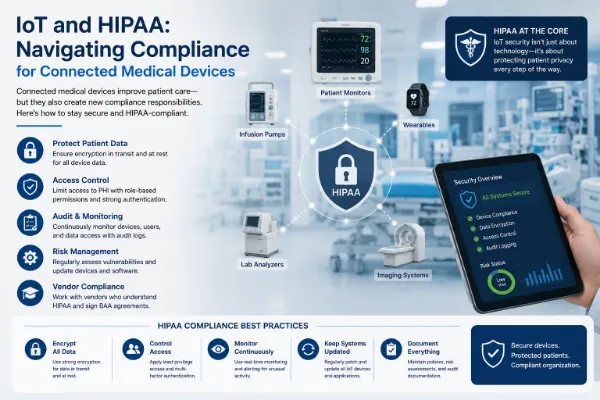
Healthcare organizations should know which devices are connected, what they collect, where data travels, who can access it and how vulnerabilities will be addressed. Our connected medical devices and healthcare data compliance guide covers related implementation concerns.
Remote care should account for broadband availability, smartphones, technical literacy, accessibility, language needs, cellular alternatives and what happens when readings stop arriving.
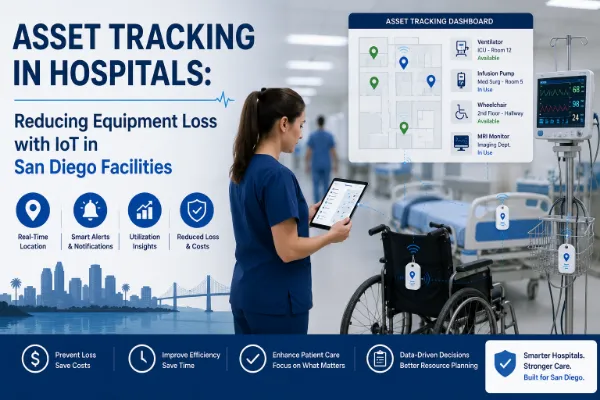
Healthcare IoT also includes operational systems. For example, hospital asset tracking with IoT addresses equipment location and utilization inside facilities.
- Select a defined patient population.
- Choose a measurable outcome.
- Design escalation workflows.
- Test the patient experience.
- Integrate before scaling.
- Review alert quality continuously.
Successful systems will increasingly collect appropriate measurements, identify meaningful changes, integrate information with clinical context and route attention to the right care team without requiring patients or clinicians to manage numerous disconnected applications.
For San Diego health organizations, the better question is not which wearable to deploy. It is what part of the care journey needs better visibility and how connected data can safely improve it.
Frequently asked questions
Connected care uses digital systems, medical devices, communications and integrated health data to exchange useful information across hospitals, clinics and home settings.
Wearables and connected home devices can collect selected health measurements outside a hospital or clinic for review according to clinical protocols.
No. Remote patient monitoring is a capability used in many programs, while Hospital-at-Home is a specific care-delivery model.
A major challenge is integrating device data into a usable clinical workflow with clear responsibility for review and response.
They can track which alerts lead to meaningful action, refine thresholds and tailor protocols to defined patient populations.
Measures can include enrollment, adherence, data availability, alert volume, response times, escalations, support needs, patient experience and relevant care outcomes.
Related articles
 Healthcare IoT