San Diego County's population of residents 65 and older is projected to double by 2030, and the fastest-growing age group in the county is 85 and up. That single demographic fact is doing more to shape how local health systems deploy remote patient monitoring than almost any technology trend on its own the region simply doesn't have enough hospital beds, geriatricians, or transportation infrastructure to manage that growth under the old model of care, where monitoring a chronic condition meant a clinic visit. IoT-connected monitoring is one of the more practical tools San Diego health systems have for closing that gap, and it's already running at meaningful scale locally, not just in pilot form.
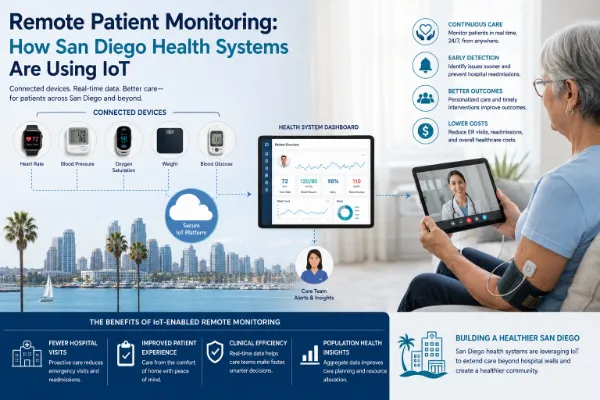
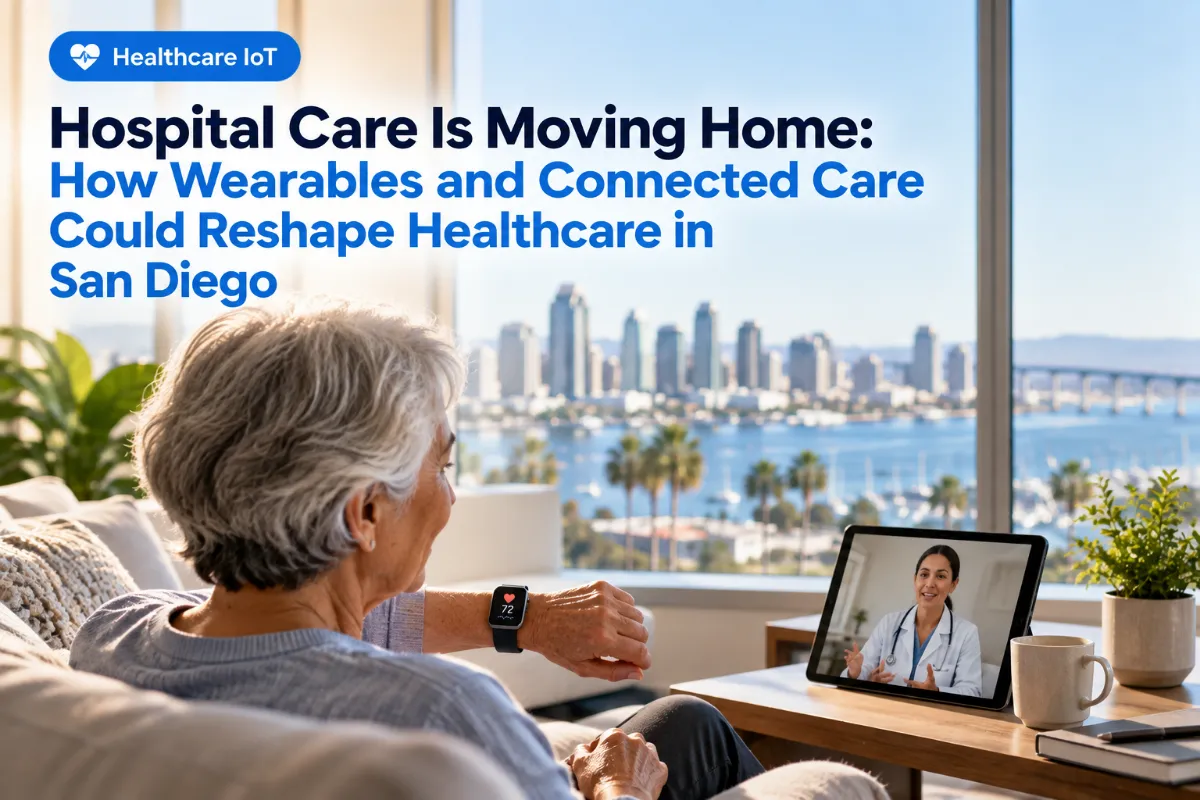
UC San Diego Health's "UCSD at Home" program is the clearest local example of remote monitoring built specifically around this demographic pressure. The program lets eligible patients, particularly seniors, receive medical care at home rather than in a clinic or hospital, using connected devices including blood pressure monitors and bed sensors that track respiration remotely. Since launching, the program has served roughly 4,000 participants, and the stated rationale from UCSD Health leadership is direct: reducing transportation burden and avoiding the stress of a hospital visit for a population where both of those factors are significant barriers to consistent care.
This connects to a broader shift in how UC San Diego Health is using connected data more generally. The health system's Mission Control Center uses AI and real-time data to coordinate patient care and transitions across its campuses, currently focused on inpatient efficiency but with an articulated goal of extending to outpatient management the same real-time, continuously updated data stream that remote monitoring devices generate is the natural input for exactly that kind of coordination layer as it expands.
The device categories doing most of the work in San Diego's remote monitoring programs are relatively unglamorous, which is part of why they work: cellular or Bluetooth-connected blood pressure cuffs and glucose monitors that transmit readings automatically rather than requiring a patient to log results manually; bed and chair sensors that track respiration, movement, and fall risk without requiring a wearable at all, which matters for elderly patients who may resist or forget a wristband; and pulse oximetry and weight scales, both particularly relevant for managing heart failure and COPD patients, where small day-to-day changes in weight or oxygen saturation can flag a developing exacerbation days before it would otherwise prompt an ER visit.
The clinical logic behind all of this is consistent: catch a small deviation early enough that a phone call or medication adjustment can prevent it from becoming a hospitalization. That's a meaningfully different value proposition than the general wellness tracking most people associate with consumer health wearables this is specifically about intervening before a chronic condition destabilizes, in a population where a single avoidable hospitalization carries real cost and real risk.
A few regional factors make remote monitoring particularly relevant to San Diego specifically, beyond the aging population figures already mentioned. The county's geography a mix of dense urban core, sprawling suburban development, and genuinely remote backcountry areas in East County creates real transportation barriers to routine in-person care for a meaningful share of the senior population, especially those who no longer drive. Remote monitoring reduces the frequency of trips that are genuinely difficult for many of these patients to make, not just inconvenient.
San Diego's competitive healthcare labor market also plays a role. With Scripps, UC San Diego Health, Sharp HealthCare, and Kaiser Permanente all competing for the same limited pool of nurses and primary care physicians, technology that lets a smaller clinical team monitor a larger patient panel safely flagging only the patients whose data actually indicates a developing problem, rather than requiring an in-person check-in for everyone on a fixed schedule has genuine operational value beyond the direct patient benefit.
Running a remote monitoring program at the scale UC San Diego Health has reached requires solving problems that go well beyond the devices themselves. Connectivity reliability matters enormously for an elderly, often less tech-comfortable patient population a device that requires troubleshooting a home Wi-Fi network defeats much of the purpose, which is part of why cellular-connected devices that don't depend on a patient's home internet have become the more common choice for this population specifically. Alert triage matters just as much: a monitoring program generating constant low-priority notifications trains care teams to deprioritize alerts generally, the same alarm-fatigue problem that shows up in industrial IoT settings, but with considerably higher stakes here. And integration with the electronic health record is what actually makes the data clinically useful a reading sitting in a separate monitoring app that a physician has to check manually provides far less value than one flowing directly into the same chart a provider already reviews during a visit.
None of this expansion happens in a vacuum separate from how it gets paid for, and reimbursement policy for remote patient monitoring has been a real determinant of which San Diego programs scale and which stay small pilots. Medicare's remote physiologic monitoring billing codes have provided a more defined payment pathway in recent years than existed when these programs first emerged, which has made the financial case for expanding beyond a single flagship program like UCSD at Home more straightforward for other San Diego systems evaluating similar investments. That said, billing requirements around minimum monitoring days per month and requirements for interactive communication with patients add real administrative overhead that health systems have to build into program design from the outset, not treat as an afterthought once the clinical model is already running.
The trajectory for San Diego health systems points toward extending remote monitoring further into outpatient chronic disease management generally, not just the home-based senior care model UCSD at Home represents today. As AI-driven coordination tools like UCSD Health's Mission Control Center mature and extend beyond inpatient settings, the connected devices generating continuous patient data become an increasingly natural fit for that same predictive, proactive coordination model flagging which outpatients need attention today, not just managing which inpatients need a bed tomorrow. Given how directly San Diego's demographic trajectory points toward more, not fewer, patients needing this kind of care outside a traditional clinic setting, remote monitoring is likely to keep expanding from where it sits today rather than plateauing as a niche program.
For San Diego families evaluating whether a program like UCSD at Home is a good fit for an aging parent, a few practical questions are worth asking directly rather than assuming the answer. Does the monitoring device require a home internet connection, or does it use its own cellular link this matters considerably for patients without reliable home Wi-Fi. What actually happens when a reading falls outside the expected range: does it trigger an automatic phone call, a nurse review within a defined window, or just a flag in a chart that gets reviewed later? And is there a clear, simple way for the patient or a family caregiver to reach a real person if something feels wrong, separate from whatever the automated system is doing? Programs that can answer these clearly tend to be the ones built with genuine operational maturity behind them, rather than a monitoring device deployed without a fully thought-out response process on the other end.
Frequently asked questions
It's a home-based care program that lets eligible patients, particularly seniors, receive medical care at home using connected devices like blood pressure monitors and bed sensors that track respiration, rather than requiring in-person clinic visits. It has served roughly 4,000 participants since launching.
San Diego County's population of residents 65 and older is projected to double by 2030, creating demand for chronic care management that the region's current clinical capacity and transportation infrastructure struggle to support through traditional in-person visits alone.
Connected blood pressure cuffs, glucose monitors, bed and chair sensors tracking respiration and fall risk, and pulse oximetry or weight scales for heart failure and COPD patients are among the most common categories.
The clinical rationale is to catch small deviations in a patient's condition early enough to intervene before they escalate into a hospitalization, though outcomes vary by condition and program design.
Mission Control Center uses AI and real-time data to coordinate patient care and transitions, currently focused on inpatient settings, with a stated goal of eventually extending to outpatient management a natural fit for the continuous data remote monitoring devices already generate.
Reliable connectivity for an often less tech-comfortable patient population, avoiding alert fatigue among clinical staff, and integrating device data directly into the electronic health record are the three most consistently cited operational challenges.
Related articles

 Healthcare IoT