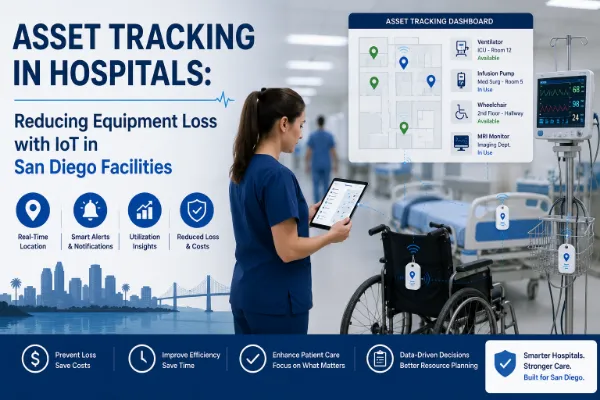
Ask any nurse working a floor shift at a busy San Diego hospital how much time they spend hunting for an infusion pump or a wheelchair, and the honest answer is often measured in the tens of minutes, not seconds. Industry-wide data puts the loss at up to an hour per shift spent searching for equipment that was in the building the whole time just not where anyone expected it to be. Multiply that across a hospital's nursing staff and a typical 300-bed facility's $1 to $2 million in annual losses from missing assets, and the case for real-time location tracking stops being a nice-to-have efficiency project and starts looking like a fairly direct financial and patient-care argument.
Hospitals are unusually difficult environments to keep track of equipment in, for reasons that compound rather than cancel out. Assets move constantly between departments, floors, and patient rooms, often without any record of the move. Staff turnover means institutional knowledge about "where things usually end up" doesn't transfer reliably. And because equipment shortages create real clinical risk, departments quietly hoard devices they're worried they won't be able to find later a rational individual response that makes the hospital-wide utilization problem measurably worse. One frequently cited real-world example: a 380-bed hospital discovered it was carrying 1,200 IV pumps at just 30% utilization before implementing tracking; after gaining real visibility into actual usage patterns, the same clinical workload only required 780 units a capital savings exceeding $1 million from a single equipment category, achieved simply by knowing what the hospital already owned and where it actually was.
Real-time location systems for hospital equipment generally rely on one or a combination of a few core technologies, each with real tradeoffs:
- Bluetooth Low Energy (BLE) beacons attached to equipment, read by receivers positioned throughout a facility, providing room-level or zone-level accuracy. This is the most common approach for general equipment tracking because it balances cost and accuracy reasonably well for most clinical workflows.
- Ultra-Wideband (UWB) delivers sub-meter, near bed-level accuracy, which matters more in surgical suites and intensive care environments where knowing which specific bay a device sits in is clinically relevant, not just which floor.
- Active and passive RFID tags support both continuous tracking and checkpoint-based visibility a passive tag read at a sterile processing tunnel entrance, for instance, doesn't require the dense reader infrastructure continuous BLE tracking does, making it a lower-cost option for inventory and custody-change tracking specifically.
- IoT condition sensors layered on top of location tracking add temperature, humidity, or vibration data critical for assets like refrigerated blood or vaccine storage, where knowing a unit's location matters less than knowing it stayed within a safe temperature range the entire time.
Most hospitals favor BLE as the primary technology specifically because it combines reasonable affordability with accuracy that's sufficient for the large majority of day-to-day workflows, reserving UWB for the smaller number of higher-acuity areas where bed-level precision genuinely changes clinical decision-making.
The search-time reduction is the most visible benefit commonly cited figures show search time reductions in the range of 90% or more once tracking is properly implemented and adopted but the operational value extends further:
- Preventive maintenance compliance. When a device's location is unknown, scheduled maintenance slips, and compliance records develop gaps that create real regulatory risk during accreditation surveys. Tracking closes that gap by making it possible to actually find equipment when it's due for service.
- Recall and cleaning management. The ability to instantly locate every unit affected by an active product recall, or every device due for terminal cleaning between uses, is a genuine patient safety function, not just an efficiency one.
- Right-sizing capital purchases. As the IV pump example above shows, real utilization data frequently reveals that hospitals own considerably more of a given asset class than actual demand requires, which directly informs and often reduces future capital equipment budgets.
- Faster accreditation preparation. Automated, timestamped maintenance and location records that used to take days to compile manually for a survey can often be pulled in minutes from a properly integrated tracking platform.
A phased deployment for a mid-size hospital typically runs six to ten weeks from an initial asset audit to full platform go-live, though high-priority, high-value assets can often go live on tracking within the first couple of weeks, delivering some operational value while the broader rollout continues. Most facilities report measurable return within roughly 90 days of initial deployment, driven primarily by reduced equipment rental costs hospitals frequently rent equipment during shortages caused by devices they already own simply being lost in the building and by avoided over-purchasing once real utilization data becomes visible. Taken together, predictive maintenance and fleet right-sizing commonly deliver a 20% to 40% reduction in total asset-related expenditure within the first year of a well-run program.
San Diego's major health systems Scripps Health, UC San Diego Health, and Sharp HealthCare among them operate across multiple campuses spread throughout the county, from La Jolla and Torrey Pines down through Chula Vista. That multi-campus structure adds a layer of complexity beyond a single-building deployment: equipment doesn't just move between floors, it sometimes moves between physically distant facilities, and a tracking platform that only provides visibility within one building misses exactly the kind of cross-campus equipment sprawl that's hardest to manage manually. Health systems operating this way increasingly favor platforms offering a single, unified dashboard across every campus and location, rather than siloed per-site tracking systems that leave the same visibility gap at the regional level that individual departments used to create at the floor level.
For a San Diego hospital administrator weighing whether to fund an asset tracking rollout, the most persuasive internal argument usually isn't the search-time statistic on its own it's connecting that statistic to a specific, already-visible cost the organization is currently absorbing. Pulling a year of equipment rental invoices and asking how many of those rentals were covering for devices the hospital already owned but couldn't locate is often a more concrete and convincing exercise than a generic industry benchmark, since it turns an abstract efficiency argument into a specific number tied to the organization's own spending. Similarly, reviewing recent accreditation survey preparation time, and how much of that time went toward manually reconstructing maintenance records that a tracking platform would have generated automatically, gives finance and compliance stakeholders a tangible reason to support the investment beyond the general patient-care framing.
- Underestimating change management. The biggest implementation challenge consistently cited by hospital technology leaders isn't the hardware, it's getting busy clinical staff to actually adopt new workflows and trust the system rather than falling back on old habits like hoarding equipment.
- Dead zones in older buildings. Facilities with a mix of older and newer construction often have coverage gaps that require careful site surveying before deployment, not after.
- Treating location visibility as the end goal. The real value comes from connecting location data to maintenance workflows, utilization analytics, and compliance reporting a system that only shows where things are, without that deeper integration, captures a fraction of the available return.
Frequently asked questions
Industry data consistently shows nurses can lose up to an hour per shift searching for mobile equipment like infusion pumps and wheelchairs, time that comes directly at the expense of patient care.
BLE provides room-level or zone-level accuracy at a lower cost and is used for most general equipment tracking. UWB delivers sub-meter, near bed-level precision at higher cost, typically reserved for surgical or intensive care environments where exact positioning matters clinically.
Most facilities report measurable ROI within roughly 90 days, and predictive maintenance combined with fleet right-sizing commonly delivers a 20-40% reduction in total asset expenditure within the first year.
Major San Diego health systems operate across multiple campuses spread throughout the county, which means equipment can move between physically distant facilities, not just floors within one building making unified, cross-campus visibility more valuable than single-site tracking.
Yes. It supports preventive maintenance scheduling, recall management, and creates automated, timestamped records that significantly speed up preparation for accreditation surveys compared to manual documentation.
Change management, not technology. Getting clinical staff to trust and actually use a new tracking system, rather than reverting to old habits like informally hoarding equipment, is consistently the harder part of implementation.
Related articles

 Healthcare IoT