For most of the last decade, energy was a line item San Diego office landlords could reasonably predict a year in advance. That's no longer true. Bundled commercial electricity rates from San Diego Gas & Electric climbed roughly 10% in early 2026, with delivery charges rising faster than generation costs a trend utility analysts expect to continue as the region's grid infrastructure ages and wildfire-hardening costs get passed through to ratepayers. For a mid-size office building, that kind of increase can erase a meaningful share of net operating income in a single budget cycle.
Landlords who've been watching this shift closely aren't just absorbing the increases or passing them through to tenants and hoping for the best. A growing number are treating energy the same way they'd treat any other controllable operating cost: measuring it precisely, automating the obvious waste out of it, and using the data to negotiate better outcomes both with utilities and with tenants. The tool doing most of that work is IoT-based building automation, and the way it's being deployed in San Diego in 2026 looks different than it did even three or four years ago.
San Diego's 2026 rate environment isn't an isolated blip. Delivery infrastructure costs, wildfire mitigation spending, and the state's broader transition away from flat retail rates have combined to push commercial electricity costs up faster than inflation for several years running. For asset managers underwriting office buildings, this has turned energy exposure into something closer to an interest-rate risk than a routine operating expense a variable that shows up directly in capitalization-rate math and, increasingly, in what buyers are willing to pay for a building.
The logic is straightforward once you run the numbers. A building that permanently cuts $40,000 to $50,000 a year in energy spend through better controls doesn't just save that cash at a typical office cap rate, that reduction in operating expense translates into several hundred thousand dollars of added asset value. That's a meaningful reason smart building investments have moved from the "nice amenity" column into underwriting models for landlords evaluating refinancing or a sale.
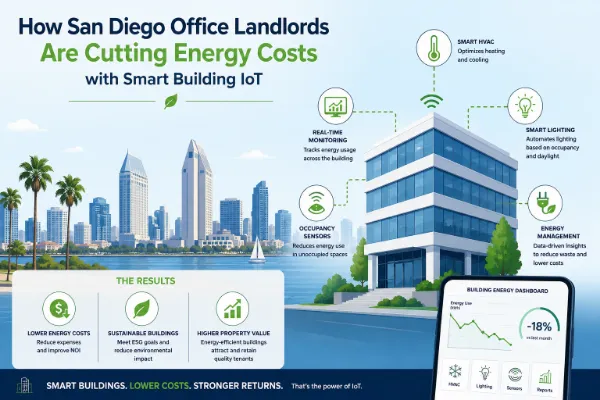
The phrase gets used loosely, so it's worth being specific about what's actually being installed in San Diego office buildings right now to cut energy costs:
- Submetering and circuit-level monitoring: Current transformers clamp onto electrical panels to measure consumption by floor, tenant suite, or even individual HVAC unit without cutting power during installation. This turns "the building used more electricity this month" into "Suite 400 ran its HVAC eleven hours after close on Tuesdays," which is an actionable finding instead of a mystery.
- Wireless environmental sensors: Battery-powered temperature, humidity, occupancy, and CO2 sensors that mesh-network independently of the building's IT infrastructure, which sidesteps a lot of the network security concerns that used to slow these projects down.
- Building automation system (BAS) upgrades or overlays: Either replacing an aging BAS outright or layering a modern, cloud-connected control layer on top of an existing one so HVAC and lighting respond to real-time occupancy rather than fixed schedules.
- AI-driven optimization software: Once sensor and BAS data is flowing, software that continuously adjusts setpoints, pre-cools before occupancy, and identifies equipment running outside normal parameters catching problems before a tenant calls to complain.
Most successful projects don't deploy all four at once. They start with submetering and occupancy sensing in the highest-consumption zones usually HVAC, since it typically accounts for 40–50% of an office building's total energy spend and expand from there once the data proves out the savings.
Cost is where a lot of landlords get stuck, partly because "smart building" pricing varies enormously depending on scope. As a rough guide for 2026 project budgets:
| Approach | Typical Cost Range | Best Fit For |
|---|
| Wireless sensor overlay (no existing BAS) | $0.50–$1.50 per square foot | Older buildings with little or no automation |
| BAS integration and gap-filling sensors | $0.25–$0.75 per square foot | Buildings with a basic BACnet or LonWorks system already in place |
| Full BAS replacement | $2.50–$7.50 per square foot | Buildings with failing or obsolete control systems |
| AI optimization layer added to an existing BAS | $0.05–$0.15 per square foot, monthly | Buildings that already have decent controls but underuse them |
On the return side, buildings that combine occupancy-driven HVAC scheduling with submetering commonly report energy savings in the 15% to 30% range, with payback periods between one and four years depending on the starting point. Utility rebate programs can meaningfully shorten that payback SDG&E and third-party incentive programs have offered prescriptive rebates for demand-controlled ventilation and building automation upgrades that can offset a five-figure share of a mid-size project's cost before a single kilowatt-hour is saved.
Three local factors make San Diego's energy landscape a bit different from other California metros, and all three intersect with smart building investment decisions.
First, the City of San Diego's Building Energy Benchmarking Ordinance requires commercial buildings over 50,000 square feet to report annual energy data through ENERGY STAR Portfolio Manager by June 1 each year. Buildings that can't produce clean, granular consumption data scramble every spring to reconstruct it from utility bills. Buildings with submetering and an automated data pipeline just export the report.
Second, updated Title 24 energy code requirements are pushing higher efficiency standards into any building undergoing significant tenant improvement work, which means landlords doing TI buildouts anyway are increasingly bundling smart controls into that scope rather than treating them as a separate project the marginal cost is far lower than a standalone retrofit.
Third, California's shift to the Net Billing Tariff has changed the math on rooftop solar considerably. Under NBT, the value of exported solar power depends heavily on when it's exported relative to grid demand, which means solar-plus-storage systems need to be paired with intelligent, load-aware dispatch to capture full value a battery that simply charges during the day and discharges at a fixed time leaves money on the table compared to one coordinated with a building's actual IoT-monitored load profile.
The technology isn't usually the hard part. The friction shows up in a few predictable places:
- Multi-tenant billing disputes: Submetering surfaces real usage differences between tenants that were previously masked by square-footage-based allocation, which can trigger pushback from tenants whose bills go up once actual consumption is measured.
- Legacy system integration: Buildings with older BACnet or proprietary control systems sometimes need middleware to bridge old hardware to modern cloud platforms, adding cost and vendor coordination that wasn't in the original budget.
- Network security concerns: IT and facilities teams don't always agree on how building IoT devices should sit relative to the corporate network, and unresolved disagreements here can stall projects for months.
- Underestimating the data cleanup: Getting existing BAS points correctly labeled and mapped to a standardized naming scheme is unglamorous, manual work that's easy to underbudget.
The next phase of adoption in San Diego's office market is less about adding sensors and more about making better use of the data already being collected. Digital twin modeling simulating a building's energy behavior before committing capital to a retrofit is moving from a large-portfolio novelty into something mid-size landlords are starting to request for major HVAC decisions, since it reduces the risk of over- or under-sizing an investment. AI optimization layers are also becoming more standard as a lower-cost add-on to existing BAS infrastructure, rather than requiring a full system replacement to get meaningful gains.
The common thread across all of it: landlords who can show tenants and lenders a clean, credible energy performance record not just a promise of efficiency, but verified data are starting to see that translate into real leasing and valuation advantages in a rate environment that isn't getting any friendlier.
Frequently asked questions
Most buildings that combine occupancy-based HVAC scheduling with submetering report savings between 15% and 30% on energy spend, though the exact figure depends heavily on the building's age, existing controls, and how aggressively the optimization is tuned.
Not usually. Many landlords add a wireless sensor overlay or an AI optimization layer on top of an existing BAS rather than replacing it outright, which is significantly cheaper and can still capture a large share of the available savings.
Yes. Buildings with submetering and automated data collection can generate the annual ENERGY STAR Portfolio Manager report needed for the city's Building Energy Benchmarking Ordinance far more easily than buildings reconstructing usage from manual utility bill records.
SDG&E and related incentive programs have periodically offered rebates for demand-controlled ventilation, building automation upgrades, and verified energy savings. Availability and rebate amounts change, so it's worth confirming current programs before finalizing a project budget.
Under NBT, the value of exported solar power depends on timing relative to grid demand. Pairing solar and battery storage with IoT-based load monitoring allows for smarter dispatch decisions that can capture more value than a system operating on a fixed schedule.
Trying to deploy sensors everywhere at once instead of starting with the highest-consumption systems, usually HVAC, and expanding based on measured results. A phased approach reduces upfront cost and gives facility teams time to calibrate before scaling up.
Related articles

 Smart Buildings