Connected construction is often sold around the jobsite: track equipment, monitor environmental conditions, document progress and reduce rework. But the most expensive missed opportunity can happen after construction ends.
Sensors are removed. Temporary dashboards disappear. Building information is archived. Facility teams receive documents and models, but not necessarily the live operational context that made connected construction useful in the first place.
For San Diego developers, contractors and property owners, the next stage of construction IoT is therefore not simply putting more sensors on jobsites. It is designing the project's data architecture so useful information survives commissioning and becomes part of building operations.
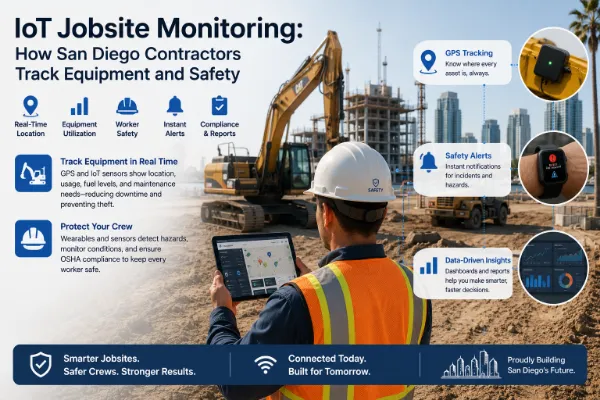
IoT is not new to construction. Connected devices can monitor equipment location, temperature, humidity, vibration, concrete conditions, access points, noise and other jobsite variables.
Our existing guide to IoT jobsite monitoring for San Diego contractors explains how these tools can support equipment management and safety. We have also examined jobsite sensors and digital twins in San Diego housing.
Construction teams and facility teams frequently want different information. A superintendent may need today's concrete conditions. A facility manager may later need equipment identity, location, commissioning performance and maintenance history.
| Construction Data | Potential Operational Use |
|---|
| Equipment identity and location | Asset registry and maintenance |
| Commissioning measurements | Performance baseline |
| HVAC sensor configuration | Energy and comfort monitoring |
| Meter architecture | Energy and water analytics |
| Digital model | Facility navigation and asset context |
Owners should ask what they will want to know during the first year of operation. Which equipment consumes the most energy? Which spaces generate comfort complaints? Which systems are expensive to maintain? Where are water leaks most consequential?
This is especially relevant to owners planning smart building deployments in San Diego.
When mechanical and electrical systems are tested before occupancy, the project generates evidence of how equipment behaves under expected conditions. Preserving these values gives facility teams a baseline against which later operating behavior can be compared.
Our analysis of digital twins in San Diego construction discusses the difference between a static model and a continuously updated representation of the physical asset.
For operations, the useful question is whether a facility manager can select an asset and access information that helps make a decision.
Annual energy benchmarking and continuous building monitoring serve different purposes. IoT can help explain what happens between reporting periods. Property owners can also read our real-time energy monitoring guide for San Diego facility managers.
- A consistent asset naming system.
- Defined data ownership.
- Open export capability.
- Commissioning baselines.
- Facility-team participation before technology decisions are locked in.
A connected building inherits technology decisions made during design and construction. Before occupancy, owners should have an accurate inventory of connected systems, network architecture, device ownership, update responsibilities and access privileges.
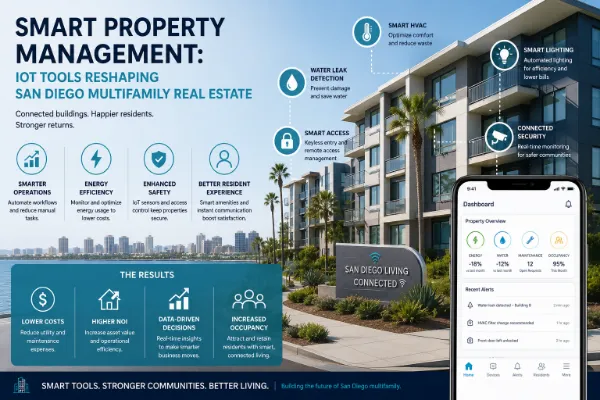
For multifamily projects, owners may prioritize water leak detection, common-area HVAC, access systems, parking infrastructure and energy use. Our guide to smart property management IoT for San Diego multifamily buildings explores these applications.
At design, define operational outcomes. During procurement, confirm equipment exposes required data. During construction, maintain the asset registry. During commissioning, capture performance baselines. At turnover, transfer credentials, records and documentation. After occupancy, review the first months of data while commissioning knowledge remains available.
The most important evolution may be the convergence of construction data and operating data. San Diego developers who address that boundary early can avoid paying once to create digital information during construction and again to reconstruct it after occupancy.
Frequently asked questions
It is the transfer of useful connected-device information, asset records, commissioning baselines, network documentation and operational access from the construction team to the building owner.
No. Retain information with an ongoing operational, maintenance, compliance, warranty or energy-management purpose.
BIM describes the designed and constructed asset, while an operational digital twin connects useful building information with current physical-system data.
It establishes an early performance baseline against which later equipment behavior can be compared.
Ideally during design, before technology specifications and integrations are finalized.
Owners should receive inventories of connected systems, network architecture, administrative access information, update responsibilities and integration documentation.
Related articles


 Construction & Real Estate