Ask a San Diego developer whether they use Building Information Modeling and the answer, in 2026, is almost certainly yes BIM adoption has crossed 78% among U.S. architectural firms with more than 50 employees, and local commercial construction firms describe it as baseline practice on virtually every forward-thinking project in the region. Ask that same developer whether they're using a genuine digital twin, though, and the answer gets murkier fast. The two terms get used almost interchangeably in marketing material, but they're meaningfully different technologies, and understanding that difference is the real question behind whether San Diego is actually ready for digital twins or just further along with BIM than it might realize.
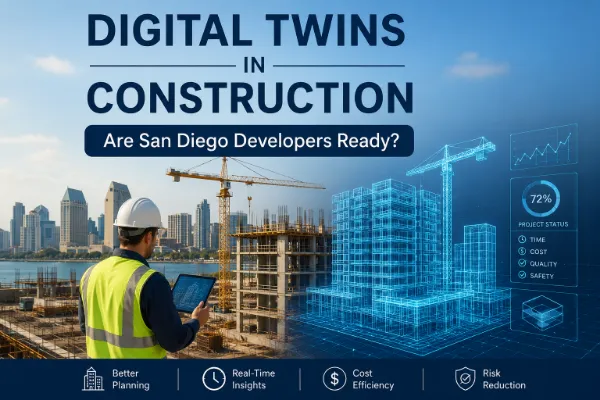
A BIM model represents design and construction intent: a detailed, data-rich 3D representation of what a building is supposed to be and how it should be built. A digital twin goes further it's a continuously updated digital replica that receives real-time operational data from the physical asset itself, reflecting how a building actually exists and performs, not just how it was designed. The distinction matters because it changes when the technology delivers value: BIM's payoff is concentrated in design and construction, largely finished at handover, while a digital twin's value compounds over the building's entire operating life, fed by ongoing IoT sensor data on everything from HVAC performance to structural movement.
Most San Diego developers today have strong BIM practices and, in some cases, an incomplete or aspirational digital twin a model that was rich and current at the point of construction handover but that stops updating once the building is occupied, effectively reverting to a static 3D drawing rather than a living replica. Closing that gap is the real adoption challenge, not building the initial model.
Coastal construction offers the clearest local example of this technology delivering genuine value today, not as a hypothetical future capability. With updated coastal bluff setback guidance arriving in mid-2026 that uses segment-specific erosion rates rather than regional averages for areas like Pacific Beach, La Jolla, and Bird Rock, and Coastal Development Permit requirements applying to any property within 300 feet of the mean high tide line, BIM's modeling capabilities have become genuinely essential rather than optional for builders working these constrained lots. Builders using BIM can visualize these erosion and setback requirements in 3D, identify conflicts early, and optimize designs for sites where every foot of buildable area is contested a direct, practical payoff that has nothing to do with digital twin hype and everything to do with navigating a specific, real regulatory requirement well.
This is a useful pattern to notice: San Diego's most successful digital modeling adoption isn't happening because developers decided to chase a technology trend. It's happening because a specific local regulatory or site condition coastal erosion risk being the clearest example made the modeling capability directly necessary rather than optional.
For developers ready to extend beyond BIM into an operational digital twin, the documented value tends to cluster in a few areas: energy performance optimization, where digital twins have supported reported reductions in the 15% to 30% range by continuously tying real HVAC and lighting behavior back to the design model; maintenance cost reduction, with reported figures in the 10% to 25% range from catching equipment issues earlier through continuous condition data rather than periodic manual inspection; and, notably, project delivery itself construction teams using integrated BIM and digital twin workflows during the build phase report rework and logistics cost reductions as high as 80% on high-performing projects, alongside schedule acceleration measured in months rather than weeks.
Those figures deserve an honest caveat: they represent outcomes from high-performing pilot projects and shouldn't be read as a typical result any developer can expect by default. Broader digital twin adoption across the construction industry remains genuinely constrained by interoperability gaps between BIM, IoT, and facility management platforms, uneven data quality, and the reality that many organizations underinvest in the process and workforce training needed to actually use the data a sophisticated model produces technology alone doesn't improve outcomes without clear internal workflows built around it.
Across the industry, and San Diego is no exception, the consistent finding is that creating the initial model isn't the hard part. Integration is the bottleneck: connecting a BIM model to live IoT sensor data, a computerized maintenance management system, and ongoing facility operations software, then keeping all of it synchronized as a building ages, gets renovated, and changes hands between owners. This is a genuinely different skill set than producing a beautiful, clash-detected design model, and it's where a lot of otherwise well-executed BIM projects stall out before becoming a true digital twin.
For San Diego developers specifically, this argues for a fairly practical readiness test: rather than asking "should we invest in digital twin technology," the more useful question is "do we have a specific, well-defined operational problem this would solve." The construction industry's most cited successful digital twin deployments from major commercial towers to complex urban infrastructure consistently started with a clearly defined operational problem, not a technology-first mandate to have a digital twin because competitors were getting one.
- Is your BIM data actually clean and current at handover? A digital twin built on incomplete or inconsistent as-built data inherits those problems permanently data quality issues compound rather than resolve themselves over a building's operating life.
- Do you have a specific operational problem in mind? Energy optimization, predictive maintenance, and coastal erosion compliance are all well-proven use cases. A general ambition to "have a digital twin" without a defined problem tends to stall.
- Who owns the model after handover? Digital twins require ongoing governance someone responsible for keeping the model synchronized with reality which is a facilities management function, not just a construction deliverable.
- What's your realistic budget for integration, not just licensing? Platform costs are often the smallest line item; data preparation, IoT integration, and staff training typically represent the larger and more variable share of total cost.
Much of the digital twin conversation focuses on large commercial towers and major infrastructure, which can make the technology feel out of reach for the mid-size developers and design-build firms that make up a large share of San Diego's actual construction market. In practice, the realistic entry point for these firms usually isn't a full operational digital twin at all it's simply making sure BIM data doesn't get discarded at handover the way it traditionally has. Structuring contracts so the as-built BIM model, rather than a stack of PDF drawings, becomes the official handover deliverable to a building owner or facilities team costs relatively little to implement and creates the foundation a future digital twin would need, even if the immediate project has no plans to build one. That single contractual change is arguably the highest-leverage step a mid-size San Diego firm can take toward digital twin readiness without committing to the larger integration investment described above.
The honest 2026 answer to whether San Diego developers are ready for digital twins is: increasingly yes, but selectively rather than universally. The region's BIM maturity, driven substantially by the genuine, practical need to navigate coastal regulatory complexity well, provides a real foundation that many markets lack. What's still developing is the operational discipline data governance, cross-platform integration, and facilities team buy-in needed to turn that foundation into a living digital twin rather than a beautifully detailed model that goes stale the day the building opens.
Frequently asked questions
BIM represents design and construction intent as a static, detailed 3D model. A digital twin is a continuously updated replica that receives real-time operational data from the physical building throughout its life, reflecting how the asset actually performs, not just how it was designed.
Primarily on BIM, which is genuinely strong locally, particularly for coastal construction navigating erosion and setback regulations. Full operational digital twins remain less common and are adopted more selectively, tied to specific problems rather than universally.
New 2026 coastal bluff setback guidance uses segment-specific erosion rates for areas like Pacific Beach and La Jolla, and Coastal Development Permit requirements apply within 300 feet of the mean high tide line BIM's 3D modeling helps builders navigate these constraints and optimize designs on genuinely difficult sites.
Integration, not modeling. Connecting a BIM model to live IoT data, maintenance systems, and facility operations software, and keeping it synchronized over the building's life, is a harder and more sustained undertaking than producing the initial design model.
High-performing pilot projects have reported energy reductions of 15-30%, maintenance cost reductions of 10-25%, and construction-phase rework reductions as high as 80%, though these figures represent strong outcomes rather than typical, guaranteed results.
It depends on whether there's a specific operational problem to solve. Smaller developers without a clear use case, like the coastal erosion modeling example, may get more value from strong BIM practices alone rather than pursuing a full digital twin prematurely.
Related articles

 Construction & Real Estate