Replacing a water meter sounds like a billing project. At San Diego's scale, it is an infrastructure-data project.
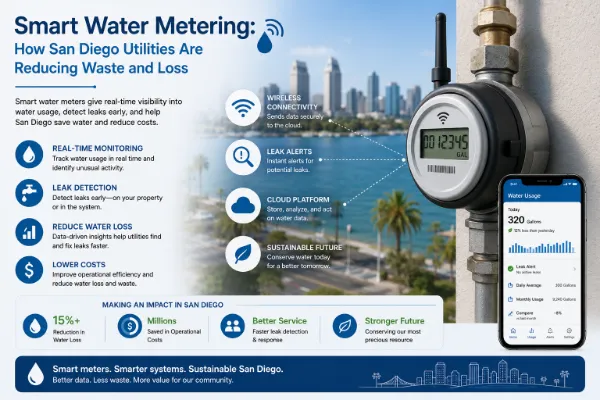
The City of San Diego's smart-metering program covers approximately 280,000 water meters and is intended to replace or retrofit meters with technology capable of electronic readings. The operational promise goes beyond eliminating manual reads. More frequent consumption information can help identify abnormal use, support leak detection and give customers better visibility into water consumption.
For a region where water is expensive and conservation matters, the difference between a monthly meter reading and a continuous stream of usage information is significant.
The real value of advanced metering infrastructure, or AMI, will depend on what San Diego does with the data after the meters are connected.
AMI is a system, not a meter.
The endpoint records consumption. A communications network transports readings. A head-end system manages meter communications. Meter-data software validates and organizes readings. Billing and customer systems consume the information. Analytics can then look for patterns such as continuous flow or unusual increases.
Our Smart Utilities in San Diego hub covers the wider connected-infrastructure landscape.
| AMI Layer | Function | Potential Value |
|---|
| Smart meter | Measure consumption electronically | More frequent usage information |
| Communications | Transmit readings | Remote data collection |
| Meter data platform | Validate and organize readings | Reliable billing and analytics |
| Leak analytics | Identify abnormal continuous use | Earlier customer notification |
| Customer portal | Present usage information | Better consumption visibility |
A traditional meter can accurately record total consumption while providing little information about when the water was used.
More frequent interval readings create a pattern. If water flows during nearly every interval across multiple days, the pattern may indicate a leak or another continuous-use condition.
The system does not necessarily know whether the cause is a leaking toilet, irrigation problem or legitimate continuous process. It can identify that the pattern deserves attention.
That is fundamentally different from discovering abnormal use when a bill arrives.
Smart meters primarily observe consumption at customer service points. Acoustic sensors can listen for characteristics associated with leaks in distribution pipes.
San Diego can therefore use multiple sensing layers. AMI helps identify unusual customer-side or service-level consumption patterns, while network leak-detection technologies can help utilities investigate water loss in buried infrastructure.
Our article on acoustic sensors and AMI for San Diego water loss examines how the technologies complement each other.
A utility cannot inspect every underground pipe continuously. Data can help narrow the search.
Utilities can compare water entering a pressure zone with metered consumption, known operational use and other measurements. Unexpected differences can indicate areas that deserve investigation.
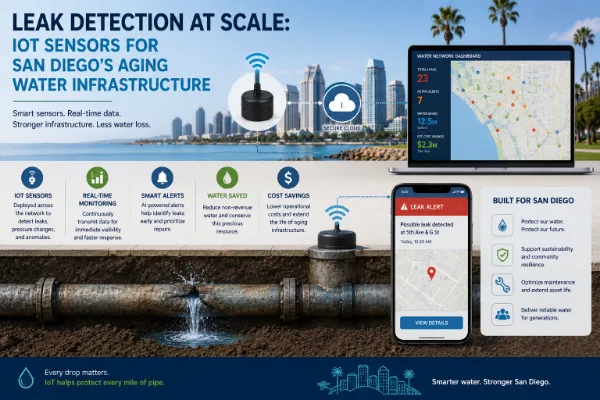
Our guide to IoT leak detection across San Diego's water infrastructure explains this network-level approach.
Monthly or bimonthly totals are backward-looking. By the time a customer sees unusual consumption, the water has already been used.
More timely usage information can make conservation more actionable. A household can see whether irrigation changes reduced consumption. A property manager can investigate a building whose overnight use suddenly increases. A business can compare operating days with closed periods.
The customer portal therefore becomes part of the conservation infrastructure.
A utility meter shows total water entering a property. It does not necessarily explain which internal system consumed it.
Commercial buildings, campuses and multifamily properties can add submeters or leak sensors at high-risk locations. If utility-level consumption increases, internal measurements can help isolate the cause.
This creates a hierarchy similar to smart-building energy monitoring: start with the main meter, then add detail where the cost or risk justifies it.
With hundreds of thousands of connected meters, data quality cannot be handled as an occasional cleanup task.
Utilities need processes for missing reads, communications failures, meter replacements, clock synchronization and readings that appear physically implausible.
An analytics system that treats a communications gap as zero consumption can produce misleading results. Validation rules should distinguish between actual water behavior and technology behavior.
Water meters are installed in challenging places: pits, vaults, basements and locations surrounded by concrete or other radio obstacles.
No communications design should assume every endpoint has identical signal conditions. Network planning needs coverage testing, retry strategies and procedures for endpoints that remain difficult to reach.
Battery life also matters. A communications configuration that transmits unnecessarily often can increase maintenance cost across a large fleet.
Connected utility endpoints create a larger digital asset inventory. Security needs to cover device identity, communications, backend access, software updates and vendor support.
Customer usage data also deserves appropriate protection. Detailed interval information can reveal patterns about property activity even when it does not identify exactly what caused the consumption.
Utilities should collect and retain information according to operational and customer-service needs rather than assuming more data is always better.
If every unusual spike creates an alert, customers may begin ignoring notifications. If thresholds are too conservative, meaningful leaks may continue unnoticed.
A better system can consider duration, magnitude and normal historical patterns. A continuous low-volume flow may deserve attention even though it never creates a dramatic spike.
Different customer types may also need different logic. A restaurant, single-family home and industrial facility do not have the same normal consumption pattern.
- Measure accurately. The endpoint must produce reliable consumption data.
- Communicate reliably. Missing data should be visible and recoverable.
- Validate readings. Software should distinguish plausible use from device or network errors.
- Detect meaningful patterns. Analytics should identify continuous or unusual consumption.
- Notify the right person. Alerts need clear customer or utility workflows.
- Verify the outcome. After a repair or behavior change, subsequent data should confirm whether consumption returned to normal.
San Diego County's water challenges cross urban and agricultural systems. Growers are using soil moisture and irrigation technology to make field-level decisions, while utilities are improving measurement at the delivery level.
Our precision irrigation IoT guide shows the agricultural side of the same measurement principle: better decisions begin with knowing where water is actually going.
Aggregated interval data can help utilities understand demand patterns at a level that periodic manual readings cannot provide.
That information can support planning, conservation analysis and investigation of unusual system behavior. However, the usefulness depends on data completeness and appropriate aggregation.
The objective should be better infrastructure decisions, not collecting granular information without a defined purpose.
The number of installed meters is an implementation metric, not the final outcome.
More meaningful measures include read success rate, reduction in manual meter-reading work, billing accuracy, number of actionable leak notifications, customer response to alerts, reduction in leak duration and the reliability of communications across the service area.
For utility operations, the city can also evaluate how AMI data contributes to broader water-loss analysis.
San Diego's approximately 280,000 water meters collectively represent one of the largest potential municipal sensor networks in the city.
But scale alone does not make the network smart. Its value comes from shortening the path between water use and awareness.
A customer should be able to learn about abnormal consumption before a surprising bill. A utility should be able to identify missing or suspicious readings automatically. Analysts should be able to compare patterns across time without waiting for manual collection.
That is the real transformation behind smart metering. The meter changes from a device primarily used to calculate a bill into a source of operational information.
For drought-conscious San Diego, the most important result will not be how many meters communicate electronically. It will be how often that information helps prevent water from being wasted before anyone notices.
Frequently asked questions
Advanced metering infrastructure combines electronic meters, communications and data systems so usage readings can be collected remotely and analyzed more frequently.
Frequent readings can reveal continuous or unusual consumption patterns that may indicate a leak, although the meter may not identify the exact physical cause.
AMI measures consumption at service points, while acoustic technologies can help identify sounds associated with leaks in distribution infrastructure.
Yes. Timelier usage information can help customers notice abnormal consumption and evaluate whether conservation or repair actions changed water use.
Challenges include radio coverage, battery life, missing readings, data validation, cybersecurity, integration with billing systems and creating useful alert thresholds.
Beyond installation counts, useful measures include read reliability, billing accuracy, actionable leak alerts, customer response, reduced leak duration and operational efficiency.
Related articles

 Smart Utilities