Every gallon of water that leaks out of an aging pipe before it reaches a San Diego home or business is a gallon that was imported, treated, and paid for, then lost without ever generating revenue or delivering value to anyone. Utilities call this non-revenue water, and in a region that imports the majority of its supply through the San Diego County Water Authority at some of the highest rates in California, it is one of the most consequential inefficiencies a local water agency can address. In 2026, the tools available to find and fix these losses have shifted decisively toward continuous, sensor-driven monitoring, replacing a detection model that for decades depended on customer complaints and visible surface breaks.
Non-revenue water includes both real losses, water that physically leaks out of the distribution system, and apparent losses, water that's consumed but never accurately billed due to meter inaccuracy or theft. Nationally, utilities lose a meaningful share of treated water before it reaches customers, and older systems with aging pipe infrastructure tend to sit at the higher end of that range. San Diego's distribution infrastructure includes pipe segments that are decades old, installed long before today's monitoring technology existed, and much of it sits underground in areas where a slow leak can go undetected for months.
What makes this a sharper problem locally than in water-abundant regions is cost. San Diego's imported water carries a price tag substantially higher than utilities drawing on plentiful local groundwater or surface supplies. A leak that might be a moderate financial nuisance for a utility with cheap, abundant local water becomes a serious budget issue for a San Diego water agency paying premium rates for every acre-foot lost before it ever reaches a customer's meter.
For most of the water industry's history, leak detection meant sending crews out with acoustic listening rods to walk pipe routes and manually check for the telltale sound of pressurized water escaping underground. This approach works, but it's slow, labor-intensive, and fundamentally reactive, crews typically investigate a specific area because a leak has already surfaced or a customer has reported low pressure, not because the system flagged a developing problem early.
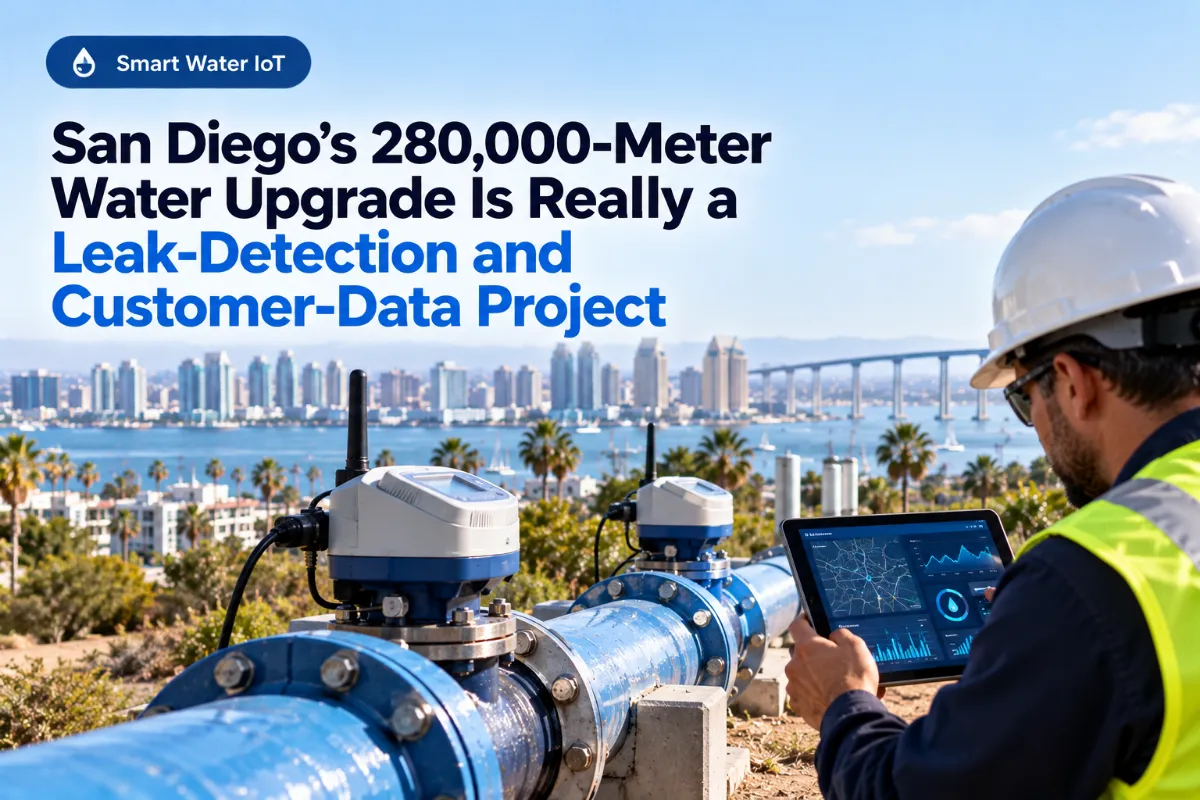
The current generation of acoustic leak detection technology inverts this model. Small, battery-powered acoustic sensors are permanently mounted on pipe networks, valves, and hydrants, continuously listening for the specific sound signature of a leak and transmitting that data wirelessly to a central monitoring platform. Rather than a periodic manual survey covering a fraction of the network at a time, these fixed sensor networks provide continuous coverage across the areas where they're deployed, catching leaks in their early stages, often long before they would surface or trigger a customer complaint.
Acoustic sensors address real losses, but advanced metering infrastructure, commonly abbreviated AMI, tackles both real and apparent losses simultaneously by giving utilities dramatically more granular visibility into consumption patterns. Unlike traditional meters that require a physical read once a month or once a quarter, AMI-equipped smart meters transmit consumption data at much shorter intervals, often hourly, allowing utilities and customers alike to see usage patterns that a monthly bill could never reveal.
For a San Diego utility, this granularity translates into several concrete capabilities:
- Customer-side leak detection. A toilet that's silently running or an irrigation valve stuck open shows up as continuous, unusual consumption that AMI systems can flag directly to a customer, often before that customer notices an unexplained spike on their bill.
- Meter accuracy and revenue protection. Aging mechanical meters tend to under-register consumption as they wear, meaning a utility can be delivering water it never accurately bills for. AMI meters maintain consistent accuracy over a longer service life, directly protecting utility revenue.
- District metering and loss localization. Dividing a distribution network into discrete metered zones allows a utility to compare water entering a zone against water billed within it, quickly narrowing down which specific areas of the network are experiencing the highest loss rates, rather than treating the entire system as a single undifferentiated problem.
- Drought response tools. During mandatory conservation periods, which San Diego has experienced repeatedly over the past two decades, granular consumption data allows utilities to identify and address the highest-usage accounts precisely, rather than relying on blunt, system-wide restrictions alone.
- Direct cost avoidance on imported water. Given San Diego's premium water import costs, reducing non-revenue water losses translates into meaningful, quantifiable budget savings, since every gallon saved from leaking is a gallon the utility doesn't need to purchase, treat, and pump in the first place.
- Deferred infrastructure replacement costs. Early leak detection allows utilities to schedule pipe repair or replacement proactively, often at a fraction of the cost of an emergency main break response that can also cause property damage and service disruption.
- Improved rate-setting defensibility. As San Diego water rates continue to rise to fund infrastructure investment and imported water costs, utilities that can demonstrate active loss reduction efforts have a stronger position when justifying rate increases to ratepayers and regulators.
- Better drought resilience. Reducing system losses effectively increases the usable supply available to the region without requiring any new imported water, an increasingly valuable capability as California's water supply reliability faces continued long-term pressure from climate variability.
- Establish a water loss baseline through a formal audit. Before investing in sensor infrastructure, utilities need an accurate picture of current loss rates and where those losses are concentrated across the distribution system.
- Prioritize district metering in the highest-loss zones first. Rather than deploying acoustic sensors uniformly across an entire system, utilities get the fastest return by targeting the zones an initial audit identifies as having the highest loss rates.
- Layer AMI rollout with acoustic sensor deployment. These two technologies complement each other, AMI illuminates consumption-side issues while acoustic sensors address the distribution network itself, and utilities that deploy both in coordination get a more complete picture than either alone provides.
- Build a dedicated data analysis and response workflow. Sensor data only creates value if there's a defined process for turning an alert into a dispatched repair crew, and utilities that skip this operational planning often end up with data nobody is acting on.
- Expand coverage incrementally, using the demonstrated savings from initial deployment zones to justify continued investment across the broader distribution network.
Capital cost versus ratepayer sensitivity. Water rates in San Diego are already a point of public sensitivity, and utilities need to carefully communicate how sensor and AMI investments translate into long-term rate stability and loss reduction, rather than simply appearing as another cost added to customer bills.
Aging infrastructure complicates retrofit. Some of San Diego's oldest pipe segments, particularly in historic neighborhoods, present physical challenges for sensor mounting and wireless signal transmission that newer infrastructure doesn't face, requiring more customized deployment planning in those areas.
Data integration across legacy utility systems. Many water utilities operate billing, asset management, and operational systems that were never designed to integrate with real-time sensor data. Bridging this gap often requires more significant systems integration work than utilities initially anticipate when budgeting a smart water project.
Workforce transition. Shifting from manual leak survey routines to sensor-driven, exception-based response requires retraining field crews and adjusting long-established operational workflows, a change management challenge that's easy to underestimate relative to the technology deployment itself.
The next stage for San Diego's water utilities involves tighter integration between acoustic leak detection, AMI consumption data, and predictive analytics that can flag pipe segments at elevated risk of failure based on age, material, soil conditions, and historical break patterns, rather than waiting for a sensor to detect an active leak. This shift toward predictive infrastructure management mirrors the direction other utility sectors, particularly electric grid modernization, are also moving, and it positions water agencies to plan capital replacement spending around actual risk data rather than fixed age-based replacement schedules alone.
As California's water supply reliability continues to face long-term pressure from drought cycles and climate variability, and as San Diego's imported water costs show no sign of a sustained decline, the case for treating water loss reduction as core infrastructure strategy, not a discretionary technology upgrade, continues to strengthen. Utilities that build this sensor infrastructure now are positioning themselves to manage both the cost and the supply reliability challenges the region will keep facing.
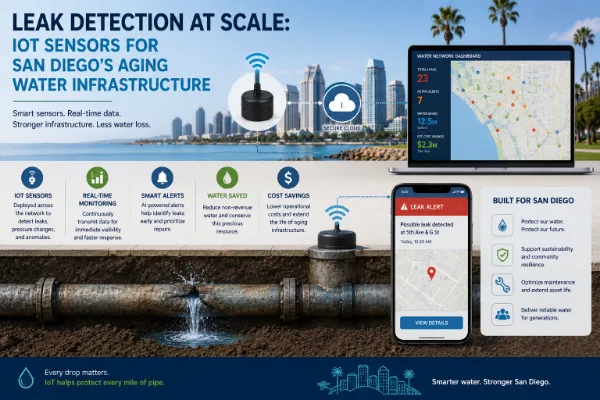
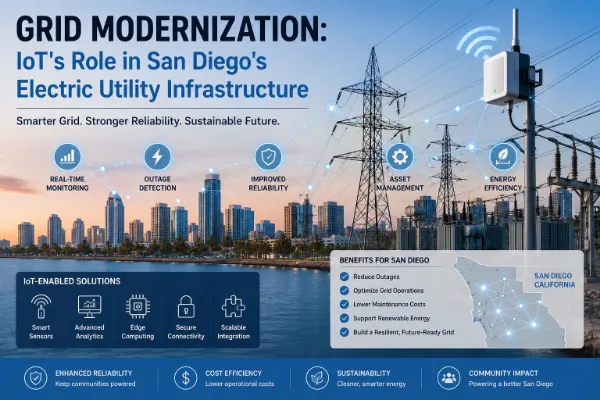
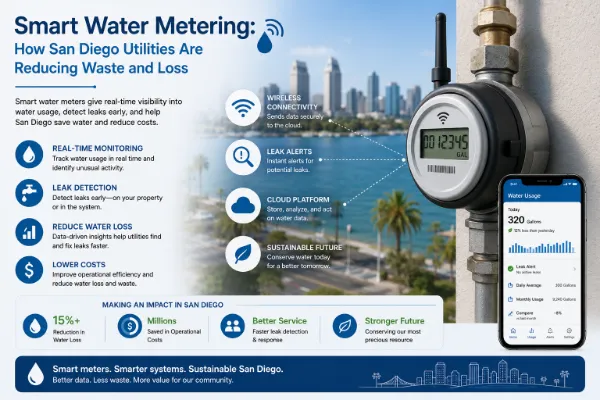
For related coverage, see our guide to smart water metering and waste reduction for San Diego utilities, our detailed look at leak detection at scale for San Diego's aging water infrastructure, and our coverage of grid modernization IoT for San Diego's electric utility sector. Explore more coverage in our Smart Utilities category or the San Diego smart utilities hub.
Frequently asked questions
Non-revenue water includes both physical leaks in the distribution system and water that's consumed but not accurately billed due to meter inaccuracy or unauthorized use. Given San Diego's high cost of imported water, even loss rates that would be a modest financial concern in a water-abundant region represent a significant, quantifiable cost locally.
Acoustic sensors mounted on pipes, valves, or hydrants continuously listen for the specific high-frequency sound signature that pressurized water makes as it escapes through a crack or joint failure. When that signature is detected, the system alerts operators to the approximate location, allowing crews to confirm and excavate only the specific area indicated, rather than searching blindly.
AMI meters themselves don't increase rates directly, though utilities may include infrastructure investment costs in future rate-setting processes like any capital improvement. The more granular data these meters provide also helps customers identify and fix leaks on their own property, which can reduce a household's own water waste and cost over time.
Timelines vary by utility and the scale of existing losses, but agencies with meaningful non-revenue water rates often see measurable savings within the first few years of a phased deployment, particularly when initial investment is targeted at the highest-loss zones identified through a water loss audit.
Yes. Granular consumption data from AMI systems allows utilities to identify high-usage accounts and communicate targeted conservation guidance more precisely than blanket system-wide restrictions, and reduced system losses effectively stretch available supply further during periods when imported water availability is constrained.
Many utilities offering AMI service provide customer portals or apps that give account holders access to their own granular consumption data, often including near real-time alerts for unusual usage patterns that could indicate a leak. Availability and specific features vary by utility, so residents should check with their local water provider.
Related articles

 Smart Utilities