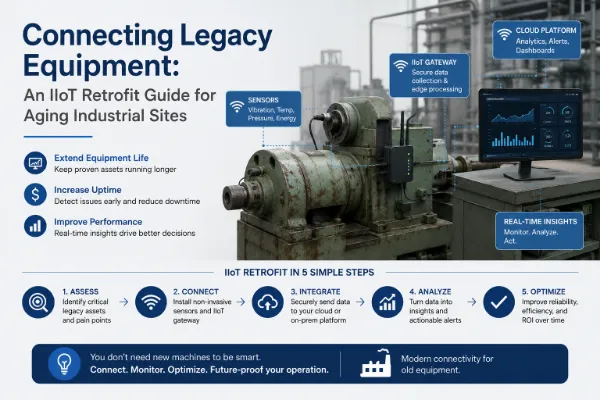
The good news for any San Diego facility manager staring at a plant full of equipment older than most of the engineers maintaining it: you almost never need to replace that equipment to bring it into an IIoT architecture. The technology for connecting legacy machinery decades-old PLCs, relay-logic systems, and hydraulic presses that predate networked control entirely has matured considerably by 2026, and the retrofit path is generally far cheaper and faster than rip-and-replace. What it requires is understanding a handful of core concepts well enough to avoid the mistakes that derail most brownfield IIoT projects.
Legacy industrial equipment generally falls into three categories, and each requires a different retrofit approach:
- Equipment with a PLC but no network connectivity. This is the most common and easiest case. Many older PLCs communicate over serial protocols RS-232 or RS-485 using Modbus RTU or proprietary vendor protocols. An edge gateway with multi-protocol support can poll this data directly and republish it over modern standards like MQTT or OPC UA, without touching the existing control logic at all.
- Equipment with a modern PLC but a closed or proprietary interface. Here, protocol converters act as translators, bridging between older industrial protocols like DeviceNet or proprietary systems and modern standards such as EtherNet/IP, Profinet, or OPC UA maintaining full operational continuity while opening up data access.
- Equipment with no PLC at all. Relay-logic machines, manual stations, and older hydraulic presses have nothing to poll. Here, an edge gateway itself becomes the data acquisition system, reading directly from retrofit sensors vibration, current, temperature added to the machine specifically for this purpose.
Almost every credible 2026 guide to legacy IIoT retrofits converges on the same recommendation: use OPC UA as the universal bridge between old and new systems. It's become the de facto standard specifically because it reduces the engineering effort of connecting equipment from different eras and different manufacturers into a single, coherent data layer rather than building a custom point-to-point integration for every individual machine, which becomes unmanageable past a handful of assets.
One important caveat worth internalizing early: IIoT connectivity should feed data out for monitoring and analytics, but it should never sit in the path of primary control signals. IIoT gateways operate asynchronously and typically can't meet the deterministic timing requirements of actual machine control, and they generally lack the safety certification required for functions like emergency shutdowns. The retrofit pattern that works is read-only data extraction alongside the existing control system, not replacing or routing through it.
For equipment that needs new sensors rather than just a protocol bridge, the cost picture has changed substantially in recent years. Instrumenting a motor with a wired vibration sensor historically ran in the range of $2,000 once installation labor was included; modern wireless MEMS-based vibration sensors have brought that down to roughly $300 per point in many cases, largely because they eliminate the conduit and cabling work that dominated the cost of older retrofit projects. That shift is a big part of why brownfield retrofitting has become the 2026 standard rather than a stopgap the economics no longer strongly favor waiting for equipment replacement.
A few physical realities are still worth planning around. Older machines often generate meaningful electromagnetic interference that can disrupt wireless sensor communication, and mounting sensors on rough, cast-iron surfaces frequently requires stud mounting or specialized adhesives rather than magnetic mounts, which tend to slip on high-vibration legacy equipment and quietly produce bad data. Battery-powered sensors also introduce a genuine logistical consideration at scale managing replacement cycles across hundreds of sensor points is a real maintenance task in its own right, not a one-time installation detail to forget about.
Retrofit IIoT projects cross the boundary between operations technology and information technology by definition, and the projects that go smoothly involve both teams from the start rather than treating this as a pure engineering exercise. A few things need to be settled before the first gateway goes online:
- Network segmentation. IIoT gateways and sensors should sit on a separate VLAN from both the corporate IT network and the primary control network, with a DMZ architecture for any gateway that bridges between segments a standard pattern in current industrial cybersecurity guidance.
- Authentication and encryption. Modern retrofit projects should default to encrypted connections (TLS-secured MQTT, for example) and device-level authentication using certificates rather than shared credentials, following the kind of guidance laid out in frameworks like NIST SP 800-82 for legacy system integration.
- Data governance. Deciding upfront which data goes where what stays on a local historian, what gets forwarded to a cloud analytics platform, and who has access avoids the ad hoc data sprawl that makes later integration with MES or CMMS platforms far harder than it needs to be.
A useful reference case from the broader industry: a food and beverage plant running packaging machinery on 1990s-era PLCs speaking proprietary serial protocols implemented a retrofit using a protocol gateway converting the legacy serial output to MQTT over TLS, paired with a local edge node running basic anomaly detection on throughput data and vibration sensors added to the main drives, all feeding the same secured message broker and segmented from corporate IT via an industrial firewall. This delivered dashboards, predictive maintenance alerts, and quality analytics without replacing a single piece of primary machinery the pattern that consistently works across brownfield retrofit projects regardless of industry.
The most consistent piece of advice across current retrofit guidance is to resist instrumenting everything at once. Start with a cluster of critical assets a known bottleneck line, particularly high-maintenance equipment, or a production cell with recurring quality issues prove the approach delivers real value there, and expand from a position of demonstrated success rather than a theoretical plan. This mirrors the phased approach that works for predictive maintenance programs generally: broad, all-at-once deployment is consistently the pattern behind stalled or abandoned IIoT retrofit projects, while narrow, proven pilots reliably build the internal case for expansion.
A recurring practical constraint in retrofit projects, San Diego facilities included, is that a lot of legacy equipment simply can't be taken offline for an extended installation window without a real production or revenue impact. This is one of the strongest arguments for prioritizing wireless retrofit sensors and non-invasive protocol gateways over anything requiring a hardwired connection into existing control cabinets. Current transformers that clamp onto electrical panels without cutting power, and battery-powered vibration and temperature sensors that mount externally without any wiring into the machine's control system, can typically be installed during normal operating hours with minimal disruption a meaningfully different proposition than a legacy wired retrofit, which often does require scheduled downtime to safely open control cabinets and run new cabling.
San Diego's manufacturing base includes a meaningful share of facilities particularly in legacy defense manufacturing, precision machining, and older industrial parks around Kearny Mesa and Otay Mesa running equipment that predates modern connectivity by decades. The retrofit path described here applies directly to that equipment, and the falling cost of wireless retrofit sensors has meaningfully lowered the barrier for mid-size manufacturers who couldn't previously justify the capital cost of a full automation upgrade. For San Diego facilities operating under defense contracting requirements specifically, the network segmentation and authentication practices described above aren't just good practice they typically overlap substantially with existing federal supply chain security expectations, making a well-architected retrofit project easier to justify from a compliance standpoint as well as an operational one.
Frequently asked questions
No, in most cases. Edge gateways and protocol converters can extract data from existing PLCs over their native serial or proprietary protocols and republish it in modern formats without touching the underlying control logic.
IIoT data extraction should always be read-only and run alongside the existing control system, never routed through it IIoT gateways lack the deterministic timing and safety certification required for actual machine control functions.
Modern wireless vibration and current sensors typically run around $300 per point installed, compared to roughly $2,000 for a traditional wired installation, largely due to eliminated cabling labor.
OPC UA is the most widely recommended universal bridge in current guidance, since it significantly reduces the engineering effort of connecting equipment from different eras and manufacturers into one coherent data layer.
Attempting to instrument an entire facility at once, rather than starting with a small, well-chosen cluster of critical assets and proving value before expanding.
Both. Retrofit projects cross the IT/OT boundary by nature, and network segmentation, authentication, and data governance decisions need input from both teams before deployment to avoid costly rework later.
Related articles

 Industrial IoT (IIoT)