San Diego's life sciences cluster is big enough that it's easy to lose the manufacturing story inside the research story. The region is home to well over a thousand life science companies generating tens of billions of dollars in annual economic output, and the Torrey Pines, Sorrento Valley, and UTC corridors have added millions of square feet of new lab and research space in just the past couple of years. But behind the R&D headlines sits a less-discussed reality: a lot of that growth is manufacturing GMP production of biologics, cell and gene therapies, diagnostics, and medical devices and manufacturing in this sector runs on industrial IoT in ways that look quite different from a typical factory floor.
Instrumenting a biotech production line isn't primarily about squeezing out efficiency, though that matters too. It's driven first by regulatory requirements. Good Manufacturing Practice rules require continuous, auditable records of environmental conditions, equipment performance, and process parameters throughout production not because a plant manager wants that data, but because FDA and international regulators require it as a condition of approval. That changes the IIoT calculus considerably: sensor data in a GMP facility isn't just an operational nice-to-have, it's frequently a compliance requirement with legal consequences if it's missing, inaccurate, or improperly validated.
This shows up concretely in what gets instrumented and why. Vibration sensors on pumps and motors serving cleanroom HVAC systems matter not just for maintenance planning but because an HVAC failure can compromise an entire batch's sterility. Humidity sensors matter because moisture affects powder handling, coating processes, and packaging integrity in ways that can trigger a batch deviation report. Every one of these sensors, and the software analyzing their output, typically needs to operate within a validated system under FDA's 21 CFR Part 11 electronic records requirements meaning the IIoT deployment itself becomes part of what auditors review, not just a tool sitting alongside the regulated process.
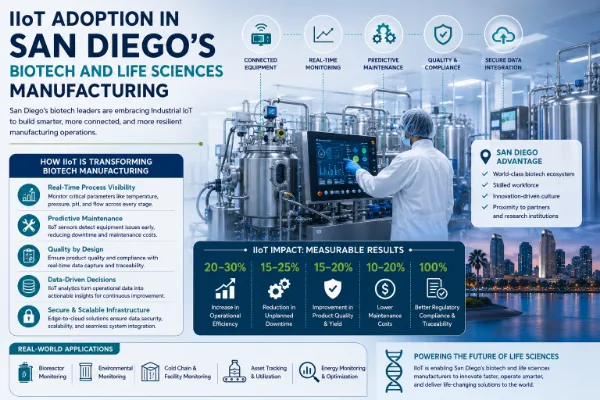
Across San Diego's biomanufacturing and CDMO facilities, a few categories of IIoT deployment show up consistently:
- Bioprocess and bioreactor monitoring: Single-use bioreactor systems, increasingly standard for smaller-batch biologics and cell therapy production, come with embedded sensors tracking dissolved oxygen, pH, temperature, and agitation in real time, feeding directly into batch records rather than requiring manual logging.
- Environmental and cleanroom monitoring: Continuous particle counters, temperature and humidity sensors, and differential pressure monitors across cleanroom suites, tied into automated deviation alerting rather than periodic manual checks.
- Cold chain and storage monitoring: Given how much of San Diego's output is temperature-sensitive biologics, continuous wireless temperature and humidity monitoring across ultra-low freezers, refrigerated warehousing, and outbound shipping has become close to universal among mid-size and larger manufacturers, with GPS and shock sensors added for in-transit shipments.
- Equipment condition monitoring: Vibration and current sensors on critical rotating equipment pumps, compressors, and HVAC systems serving controlled environments supporting predictive maintenance programs specifically designed to avoid the kind of unplanned downtime that risks an entire production batch, not just a maintenance ticket.
A recurring theme among San Diego life sciences manufacturers evaluating new IIoT technology is that the sensors themselves are rarely the bottleneck validation is. Any new monitoring system feeding into a GMP process typically needs to go through a formal qualification process demonstrating the sensors are accurate, the data pipeline is secure and tamper-evident, and the system behaves consistently under real production conditions. This is a meaningfully longer and more document-intensive process than a typical industrial IIoT rollout, and it's the primary reason life sciences IIoT adoption tends to lag general manufacturing by a step or two, even at well-resourced companies.
Regulatory guidance is evolving to make room for more sophisticated systems, though. FDA guidance addressing AI use in drug development and manufacturing now expects documented model validation, version control, and traceability for any AI-driven system touching production decisions which is pushing San Diego manufacturers evaluating AI-enhanced predictive maintenance or quality control tools to build that documentation discipline in from the start rather than retrofitting it after deployment.
A few regional factors shape how IIoT adoption is playing out locally. San Diego's proximity to Tijuana's large medical device manufacturing base means a meaningful share of the region's device production and assembly happens across the border, which adds cross-border logistics and cold chain visibility to the list of problems local IIoT deployments need to solve not just in-plant monitoring, but continuous tracking as product and components move between San Diego and Baja California facilities.
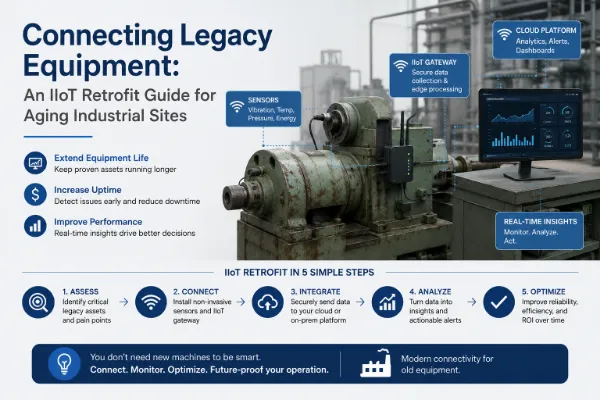
The shift toward smaller batch sizes and more flexible manufacturing driven by the growth of cell and gene therapies and personalized medicine, both areas where San Diego has a strong research base also changes the IIoT requirements compared to traditional large-batch pharmaceutical manufacturing. Flexible, reconfigurable production suites need monitoring systems that can be redeployed or reconfigured between different product runs, rather than the fixed, permanently wired sensor networks common in older, single-product facilities.
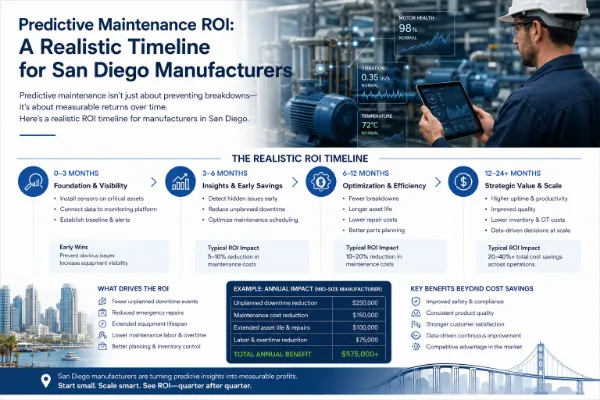
Industry-wide data suggests digital manufacturing investment in pharma and biotech can cut operating costs meaningfully figures in the range of a 30% reduction get cited regularly largely through reduced manual data entry, faster batch release, and fewer deviation investigations triggered by data gaps rather than actual process problems. That last point matters more in San Diego's regulated manufacturing environment than it would in general industry: a missing or inconsistent sensor reading doesn't just create an operational headache, it can trigger a formal deviation investigation that delays batch release and consumes significant quality team time, regardless of whether anything actually went wrong with the product.
Average overall equipment effectiveness in pharmaceutical manufacturing tends to run well below the 85% considered a world-class benchmark in general manufacturing, which points to real headroom but closing that gap requires the same phased, validation-conscious approach that characterizes successful IIoT adoption anywhere in this sector: prove value on a narrow, well-defined process step before expanding.
Given the validation burden described above, the vendor evaluation process for life sciences IIoT tools looks different than it would for a typical manufacturer. Beyond the standard questions about sensor accuracy and platform reliability, San Diego buyers evaluating a new monitoring system should specifically ask whether the vendor has prior experience supporting FDA 21 CFR Part 11 validation packages, whether the platform provides the audit trail and electronic signature capabilities regulators expect, and how the vendor handles software updates without disrupting a previously validated system state since an unplanned software change to a validated system can itself trigger a re-validation requirement. Vendors with a track record specifically in regulated pharma and biotech environments, rather than general industrial IIoT, tend to have already built these capabilities in, which can meaningfully shorten the internal validation timeline compared to adapting a general-purpose platform after the fact.
The direction of travel for San Diego's life sciences manufacturers is toward what the industry increasingly calls Pharma 4.0 continuous, connected manufacturing with real-time release testing rather than end-of-batch quality checks, digital twins used to simulate process changes before implementing them physically, and AI-assisted quality control catching anomalies during production rather than after. San Diego's dense concentration of both biomanufacturing capacity and technical talent gives it a reasonable claim to being an early adopter region for these approaches, but the regulatory validation burden means adoption here will likely continue to trail the headline pace of AI and IIoT innovation happening in the broader tech sector, by design rather than by lack of ambition.
Frequently asked questions
Any system feeding data into a GMP process typically requires formal validation demonstrating accuracy, security, and consistent performance before it can be relied on for regulatory purposes, which adds significant time compared to a typical industrial IIoT deployment.
Bioreactor process sensors, cleanroom environmental monitors, cold chain temperature and humidity sensors, and equipment condition monitoring on critical rotating machinery are the most consistently deployed categories.
Yes. A significant share of medical device manufacturing and assembly happens across the border, which extends local IIoT and cold chain monitoring needs into cross-border logistics rather than just in-plant operations.
Current FDA guidance expects documented model validation, version control, and full traceability for AI systems touching manufacturing or quality decisions, which shapes how San Diego manufacturers evaluate and deploy AI-enhanced monitoring tools.
Yes. The growth of cell and gene therapy and personalized medicine production favors monitoring systems that can be reconfigured between product runs, rather than the fixed sensor networks common in traditional large-batch pharmaceutical manufacturing.
Reducing deviation investigations triggered by data gaps or inconsistencies rather than actual process problems tends to be one of the more significant and underappreciated sources of value, alongside faster batch release from automated, continuous data capture.
Related articles

 Industrial IoT (IIoT)