By the end of 2026, Walmart expects to have electronic shelf labels running in all 4,597 of its U.S. stores, part of a broader push to automate roughly 65% of its retail locations. That kind of large-chain adoption tends to signal a technology's arrival as a genuine operational standard rather than a novelty, and for San Diego's independent boutiques, grocers, and mid-size retail chains, it raises a fair question: is this something worth adopting at a much smaller scale, or is it purely a big-box game?
The honest answer is that smart shelf technology has become considerably more accessible and modular than it was even a couple of years ago, and several pieces of it make sense for San Diego retailers well outside the Walmart scale — but which pieces, and in what order, depends heavily on what specific problem a given store is actually trying to solve.
The term gets used loosely enough to cover several genuinely distinct technologies, and it's worth separating them since they solve different problems at very different price points:
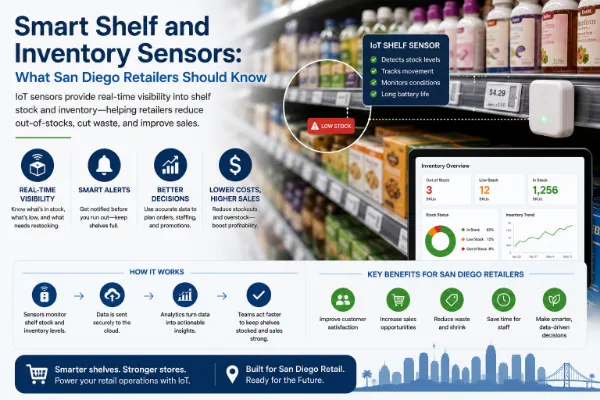
- Electronic shelf labels (ESLs): E-ink or LCD price tags that update remotely and instantly, replacing paper tags. Communication typically runs over Bluetooth Low Energy or RF, with battery life commonly running 5 to 10 years per label.
- Weight sensors: Pads or shelf-integrated scales that detect when product is removed or restocked, translating weight changes into inventory counts without requiring a barcode scan.
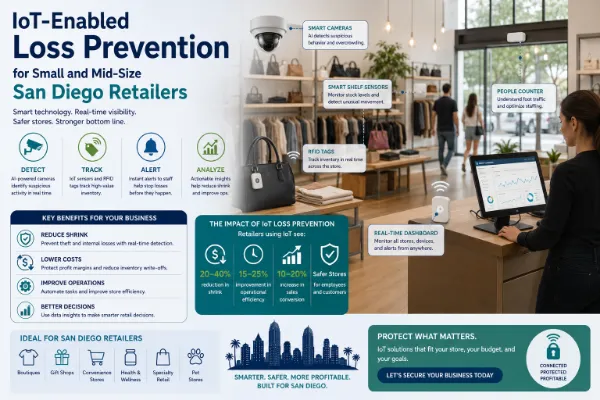
- RFID tagging: Tags embedded in or attached to products, read by shelf or gateway antennas without requiring line of sight, enabling both inventory counts and, notably, loss detection when tagged items leave the store without being properly checked out.
- Computer vision cameras: Ceiling or shelf-mounted cameras paired with AI that detect empty shelf space or misplaced items visually, without requiring the product itself to carry any sensor or tag.
These technologies are increasingly deployed together rather than as standalone systems — computer vision confirming what a weight sensor's data suggests, for instance — but a small or mid-size San Diego retailer doesn't need to adopt all four at once, or even most of them, to see real value.
For most San Diego retailers, the financial case for smart shelf technology breaks down into a few distinct categories, and it's worth being clear about which one is actually driving the investment:
Reduced out-of-stock losses. The most direct, easily measured benefit. A shelf that's empty because nobody noticed in time is lost revenue that a weight sensor or computer vision system can flag automatically, often triggering a restock alert before a customer even notices the gap.
Labor reallocation. Electronic shelf labels alone eliminate the recurring task of printing and physically swapping paper price tags — some retailers report saving well over 10,000 individual label changes a year, time that can be redirected to customer-facing tasks rather than back-of-house price maintenance.
Pricing agility and accuracy. ESLs let a retailer update prices instantly across an entire store, or run time-limited promotions without a staff member physically walking the floor. For San Diego retailers competing with online pricing that changes by the hour, this closes a real competitive gap that paper tags simply can't.
Shrinkage detection. RFID-tagged inventory that leaves a shelf without a corresponding checkout transaction is a useful early signal for both theft and administrative error — a topic worth its own dedicated discussion given how much shrinkage costs San Diego retailers specifically, covered in more depth elsewhere on this site.
Full smart shelf deployment, the kind Walmart is rolling out chain-wide, isn't a realistic or necessary starting point for an independent San Diego boutique or a regional grocery chain. A more sensible sequence:
- Start with electronic shelf labels in categories with frequent price changes. Produce, seasonal goods, and promotional end-caps see the fastest payback, since they're exactly where manual price updates happen most often and where pricing errors are most likely to occur.
- Add weight-based inventory sensors to your highest-velocity, highest-stockout-risk products. Rather than instrumenting an entire store, identify the handful of SKUs that generate the most frequent "we were out of that" customer complaints and start there.
- Layer in RFID selectively for high-shrinkage categories. Electronics, cosmetics, and other easily concealed, resellable items are where RFID-based shrinkage detection earns its cost fastest, rather than tagging every item in the store.
- Evaluate computer vision only once the above is generating clean, trusted data. It's the most capable but also the most expensive layer, and it delivers the most value once there's already a baseline inventory data system for it to confirm and enhance.
Electronic shelf labels typically run from a few dollars to around ten dollars per label depending on size and display type, which adds up meaningfully across a full store but can be phased in category by category rather than requiring a single large capital outlay. Weight sensor systems and RFID infrastructure vary more widely based on scale and whether they're integrated into existing shelving or retrofitted, but modular, retailer-scale systems have become considerably more accessible than the enterprise platforms built for national chains — a meaningful shift from just a few years ago, when smart shelf technology was effectively out of reach for anyone below big-box scale.
- Integration with your existing POS. A smart shelf system that doesn't sync cleanly with the point-of-sale and inventory management software you already run creates a second, disconnected data source rather than a genuine efficiency gain.
- Customer perception of tracking. Surveys consistently show a meaningful share of shoppers, often estimated around half, have some discomfort with in-store motion or presence tracking. Clear, simple signage explaining what's being collected and why goes a long way toward avoiding customer pushback, particularly in a market like San Diego where privacy-conscious consumer sentiment runs fairly high.
- Realistic accuracy expectations. Weight sensors can be thrown off by product repackaging or shelf reorganization, and RFID read rates vary depending on tag placement and shelf material. Budget time for calibration rather than expecting plug-and-play precision from day one.
Given how fragmented the smart shelf vendor landscape is, San Diego retailers evaluating options should push past general product demos and ask a few pointed questions. How does the system handle San Diego's specific retail mix — a boutique with frequently rotating seasonal merchandise has very different labeling and sensor needs than a grocery store with stable, high-turnover staples, and a vendor who only has experience with one retail category may not have anticipated the challenges specific to the other. What's the actual battery replacement or label lifespan under real store conditions, not just the manufacturer's laboratory rating, since humidity and temperature variation between a coastal La Jolla shop and an inland Escondido location can affect hardware longevity differently. And critically, what happens to historical inventory and pricing data if the retailer switches vendors down the line — data portability is easy to overlook during initial evaluation but expensive to discover is missing later.
As large chains normalize electronic shelf labels and connected inventory sensors at scale, the underlying hardware costs for smaller retailers are likely to keep falling, following the same pattern seen with other retail technology that started as an enterprise-only investment. For San Diego's independent and mid-size retail sector, the practical opportunity in 2026 isn't matching Walmart's scale — it's identifying the specific, narrow pain point smart shelf technology solves best for a given store, whether that's pricing agility, stockout prevention, or shrinkage detection, and starting there rather than treating full-store automation as an all-or-nothing decision.
Frequently asked questions
No. While large chains are driving broader adoption, individual components like electronic shelf labels and targeted weight sensors have become accessible enough in cost and modularity for independent and mid-size San Diego retailers to adopt selectively.
Electronic shelf labels in categories with frequent price changes, like produce or seasonal goods, tend to deliver the quickest and clearest return by eliminating recurring manual price tag changes and reducing pricing errors.
RFID-tagged inventory can help detect when items leave a shelf without a corresponding checkout, providing an early signal for both theft and administrative error, particularly useful for high-shrinkage categories like electronics and cosmetics.
Individual labels typically run from a few dollars to around ten dollars depending on size and display type, allowing retailers to phase in adoption by category rather than committing to a full-store rollout at once.
It's worth taking seriously. A meaningful share of shoppers report discomfort with in-store tracking technology, so clear signage explaining what data is collected and how it's used helps maintain customer trust.
Most modern systems are designed to integrate with common POS and inventory platforms, but this should be confirmed explicitly before purchase, since a disconnected system creates more administrative overhead than it saves.
Related articles

 Retail IoT