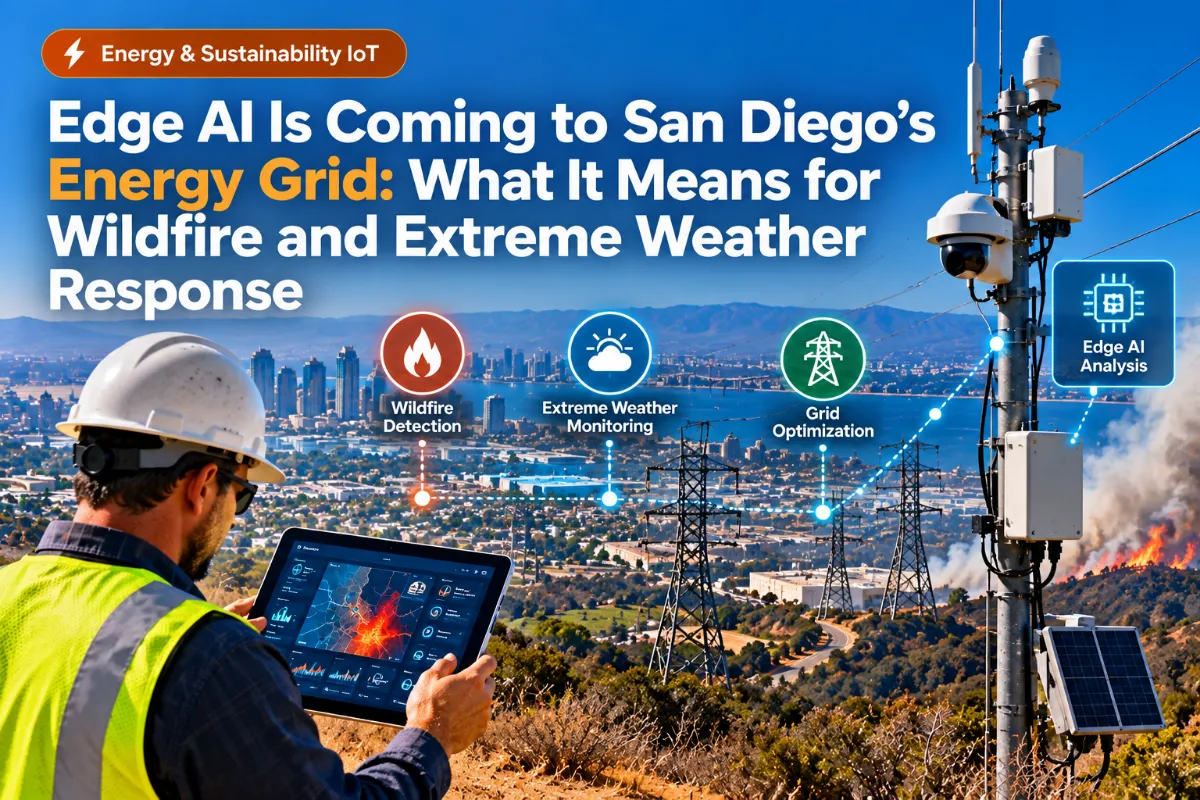
A weather sensor can tell a utility what is happening. Edge AI is intended to help determine what the measurements mean before the data has to travel back to a distant computing environment.
That distinction is becoming tangible in San Diego County through work combining environmental sensing, edge computing and atmospheric science for wildfire and extreme-weather monitoring.
A traditional IoT architecture sends sensor information over a network to a remote platform for processing. Edge computing moves part of that analysis closer to the sensor, which can matter when network quality, latency and rapidly changing local conditions affect operations.
This concept is increasingly important across energy and sustainability technology in San Diego.
San Diego already has experience with connected wildfire monitoring. Our coverage of IoT wildfire detection and sensor networks in San Diego explains the broader sensing layer. The next step is reducing the time between measurement and useful interpretation.
| Use Case | Edge Advantage | Operational Value |
|---|
| Weather monitoring | Local analysis | Faster situational awareness |
| Wildfire risk | Prioritized environmental patterns | Earlier investigation |
| Aerial inspection | On-device image analysis | Less unnecessary data transmission |
| Remote grid assets | Local anomaly detection | More targeted maintenance |
Edge and centralized computing are complementary. Edge systems can handle low-latency analysis and data reduction, while central platforms remain useful for historical analysis, model management and combining information across many locations.
The same principle applies to IoT grid modernization in San Diego.
San Diego County combines coastal conditions, mountains, inland heat, varied terrain and wildfire exposure. Localized environmental intelligence can therefore be more useful than broad regional averages when operational decisions depend on conditions at a specific asset.
Utility infrastructure is geographically distributed and expensive to inspect manually. Drones and connected inspection systems can collect imagery more frequently, while edge computer vision can help prioritize characteristics that warrant closer examination.
- What decision needs to become faster?
- What happens when communications fail?
- How will deployed models be updated and validated?
- How will operators verify and respond to alerts?
A system that produces too many low-value alerts can create alert fatigue. Edge AI should therefore be evaluated on precision, reliability, response time and integration with existing operating procedures.
Utilities should consider device identity, encrypted communications, access controls, secure updates, physical tampering and accurate inventories of deployed hardware and software.
Wildfire technology crosses energy resilience, environmental monitoring and emergency response. See our coverage of San Diego's connected wildfire detection and emergency-response systems.
The architecture is relevant beyond utilities. Industrial sites can use edge analytics for machines, commercial buildings can process occupancy and equipment information locally, and logistics operations can analyze video and vehicle telemetry near where it is produced.
The important question is no longer whether edge AI can process sensor data. It is whether local analysis produces reliable, actionable information under real operating conditions. San Diego provides a demanding environment in which that question can be tested.
Frequently asked questions
Edge AI uses computing near sensors or grid assets to analyze information locally instead of sending every datapoint to a distant platform first.
It can analyze rapidly changing local environmental conditions with lower dependence on continuous transmission of raw data.
No. Edge and centralized computing are complementary and are suited to different workloads.
Computer vision can analyze inspection imagery near where it is captured and prioritize potential anomalies for review.
Poorly tuned systems can generate excessive false positives, creating alert fatigue and unnecessary operational work.
They include device identity, encryption, access controls, software updates, physical security and accurate device inventories.
Related articles

 Energy & Sustainability