San Diego-based Qualcomm is extending on-device AI into a part of the IoT market where cost, size and long product lifecycles can matter as much as raw computing performance.
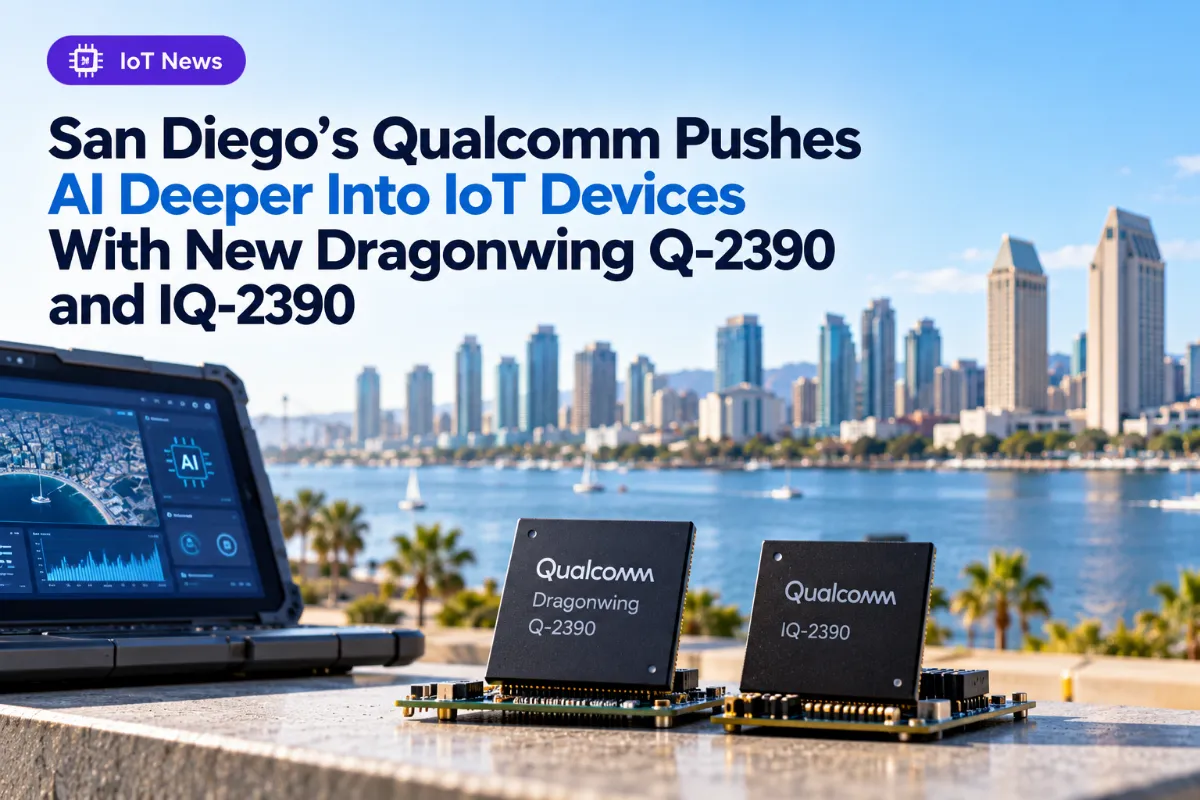
On September 1, 2026, Qualcomm Technologies introduced the Dragonwing Q-2390 and IQ-2390 processors. The two products target connected devices and industrial systems that need combinations of application processing, vision, AI and real-time functions without moving every workload to a large edge server or cloud service.
For San Diego's IoT ecosystem, the announcement is worth watching because it shows where connected-device design is heading: more processing is happening inside gateways, control panels, cameras, retail systems and other endpoints.
The Q-2390 is positioned for commercial connected-device applications, while the IQ-2390 is the industrial-grade member of the new IQ2 Series.
Qualcomm lists applications for the Q-2390 that include intelligent retail, access control, smart-home hubs, robots and enterprise terminals. The IQ-2390 targets industrial HMIs, vision systems, gateways, PLC and CNC environments, building automation, EV charging equipment, energy storage and electronic meters.
Both reflect the same broader direction: AI inference is becoming a capability inside smaller connected products rather than a feature that always requires a separate computer.
Readers following local developments can browse our San Diego IoT news hub and the Qualcomm profile in our company directory.
IoT hardware is constrained differently from laptops or data-center servers. A device may need to fit inside a control panel, run within a limited power budget, operate for many years and support a product whose software cannot be redesigned every two years.
The IQ-2390 is particularly interesting because Qualcomm describes it as supporting a 10-year product-longevity commitment and an extended operating temperature range from minus 30 degrees Celsius to 115 degrees Celsius. It also includes industrial features such as ECC memory protection and hardware-backed security.
Those details matter because industrial buyers often care about availability and lifecycle stability more than benchmark leadership.
| Capability | Why It Matters in IoT |
|---|
| Application CPU | Runs device software and higher-level applications |
| AI acceleration | Supports local inference without sending every task to the cloud |
| Image processing | Enables cameras and machine-vision workloads |
| RISC-V MCU | Supports real-time and lower-level functions |
| Ethernet and TSN on IQ-2390 | Supports industrial connectivity and time-sensitive networking |
| Cellular option on Q-2390M | Extends connected deployments beyond local wired or Wi-Fi networks |
The architectural story is integration. A product designer may be able to combine workloads that previously required multiple chips or boards.
Cloud AI is powerful, but not every connected device should depend on a round trip to a remote data center for every decision.
A retail camera may need to analyze a scene while limiting the amount of video that leaves the device. An industrial vision system may need to classify an event quickly. A building controller may need to continue operating if external connectivity is interrupted.
Local inference can reduce latency and data transmission while increasing operational independence. The tradeoff is that device makers must manage models, updates, security and compute resources across a distributed fleet.
The IQ-2390 combines capabilities that traditionally lived in separate layers of an industrial system. That creates opportunities for smarter gateways, operator panels and compact vision systems.
Our analysis of IIoT adoption in San Diego biotech and manufacturing provides context for the types of local environments where this architecture could become relevant.
However, integrating more workloads onto one device also creates design questions. Engineers need to determine which functions can safely share hardware, which require isolation and how the system behaves if a software component fails.
The commercial Q-2390 shows that edge intelligence is not confined to factories. Retail systems, access-control devices and building technologies can benefit from local vision and AI.
San Diego property operators can connect this development with our Smart Buildings in San Diego coverage, while retailers can explore the San Diego Retail IoT hub.
In both environments, local processing can be useful when applications involve video, privacy-sensitive data, rapid response or unreliable connectivity.
Qualcomm lists EV charging equipment, energy storage and electronic meters among IQ-2390 applications. These systems illustrate why industrial-grade edge hardware needs different characteristics from consumer electronics.
Energy devices may be installed outdoors, remain deployed for years and require predictable networking and secure software maintenance. AI can add anomaly detection or local optimization, but only if the underlying platform remains reliable.
Powerful silicon does not automatically translate into deployable IoT products. Device makers need operating-system support, drivers, development tools, model deployment workflows and long-term maintenance.
Qualcomm lists support for environments including Qualcomm Linux based on Yocto, Ubuntu, Android and Zephyr RTOS for the IQ-2390. This breadth is relevant because IoT developers do not work in one universal software environment.
The easier it becomes to move an existing application or model onto edge hardware, the lower the barrier to experimentation.
- Does the application actually need local AI? Avoid adding inference simply because the processor supports it.
- What data should remain on-device? Privacy, bandwidth and latency can all influence the answer.
- How long will the product remain deployed? Hardware and software lifecycle planning should match the device's expected service life.
- How will models be updated? AI model management needs the same discipline as firmware management.
- What happens offline? Define which functions continue during a network outage.
- What is the security boundary? More integrated capability makes access control and isolation increasingly important.
The September processors follow a broader expansion of Qualcomm's IoT and edge-AI portfolio. Earlier in 2026, the company highlighted technologies and capabilities associated with acquisitions including Arduino, Edge Impulse, Foundries.io, Augentix and Focus.AI.
The strategic pattern is clear: Qualcomm is not treating IoT as connectivity alone. The portfolio increasingly spans compute, AI development, device software and deployment tooling.
That is significant for San Diego because the region's role in IoT is tied not only to companies using connected devices, but to technology developed locally and deployed globally.
For years, an IoT device could be described simply as a physical object that senses something and connects to a network. That definition is becoming incomplete.
Increasingly, the device senses, interprets and decides what information is important before communicating. A camera can classify. A gateway can detect anomalies. A control panel can run a local model. A retail terminal can analyze activity without sending every raw input elsewhere.
This does not eliminate centralized computing. It changes what deserves to be centralized.
The largest AI systems attract attention because their scale is visible. The far edge may ultimately contain vastly more individual computing endpoints.
If capable AI processing becomes economical inside compact industrial and commercial devices, developers can redesign workflows around local intelligence rather than treating the endpoint as a passive sensor.
The Q-2390 and IQ-2390 are therefore interesting not because every San Diego business will buy them directly. They are interesting because they illustrate the direction of the devices businesses will increasingly encounter.
For a city with deep roots in wireless technology and a growing interest in industrial, building, energy and retail IoT, that shift is locally relevant. The connected device is becoming a computing node, and the intelligence is moving closer to where physical events actually happen.
Frequently asked questions
Qualcomm introduced the Dragonwing Q-2390 for commercial connected devices and the industrial-grade Dragonwing IQ-2390, the first processor in its new IQ2 Series.
Qualcomm lists industrial HMIs, gateways, machine-vision systems, PLC and CNC applications, building controls, EV charging, energy storage and electronic meters among target applications.
The Q-2390 targets commercial connected-device applications, while the IQ-2390 is designed for industrial environments with features and lifecycle considerations suited to industrial deployments.
It can reduce latency, bandwidth use and dependence on cloud connectivity while allowing some privacy-sensitive or high-volume data to remain local.
No. Local and cloud computing are complementary. Devices can process immediate information locally while central systems handle fleet management, historical analytics and other broader workloads.
Qualcomm is headquartered in San Diego, making the company's expanding IoT and edge-AI portfolio part of the region's technology ecosystem as well as a global product development story.
Related articles

 IOT News