San Ysidro is the busiest land border crossing in the Western Hemisphere, and Otay Mesa isn't far behind as one of the busiest commercial crossings on the entire US-Mexico border. Billions of dollars in freight, produce, electronics, medical devices, and manufactured goods from Tijuana's maquiladora sector, move through these crossings every year. For the logistics companies, freight brokers, and trucking operators managing that flow, the margin between a shipment that clears smoothly and one that sits in a multi-hour queue often comes down to one thing: whether anyone actually knows where the cargo is and what condition it's in at any given moment.
That's the specific problem IoT-connected logistics platforms are solving for San Diego's cross-border freight economy in 2026, and it looks meaningfully different from the general "supply chain visibility" pitch you'll see applied to a domestic trucking fleet in the Midwest.
Freight moving through Otay Mesa and San Ysidro faces a set of operational realities that don't exist for most US logistics operations. Wait times at the border fluctuate unpredictably based on staffing, inspection volume, and security posture, and a load that clears in twenty minutes one day might sit for three hours the next. Temperature-sensitive cargo, and San Diego's cross-border freight includes a significant volume of fresh produce, seafood, and pharmaceutical products, has to survive that uncertainty without a temperature excursion that renders the shipment unsellable or, in the case of pharmaceuticals, unusable.
Add to this the handoff complexity: cargo frequently changes carriers, trailers, or even drivers at the border, creating multiple points where a shipment can lose continuous chain-of-custody visibility if it's being tracked manually rather than through connected sensors that travel with the cargo itself.
The industry term gaining traction, port-to-door or, in San Diego's case, border-to-door orchestration, describes IoT-connected platforms that maintain continuous visibility across every handoff in a shipment's journey rather than only tracking it at fixed checkpoints. For San Diego's cross-border freight operators, this typically involves several connected layers working together:
- GPS and cellular asset trackers attached directly to trailers or high-value cargo, providing continuous location data through the border crossing and onward delivery, rather than relying on carrier check-ins at each leg.
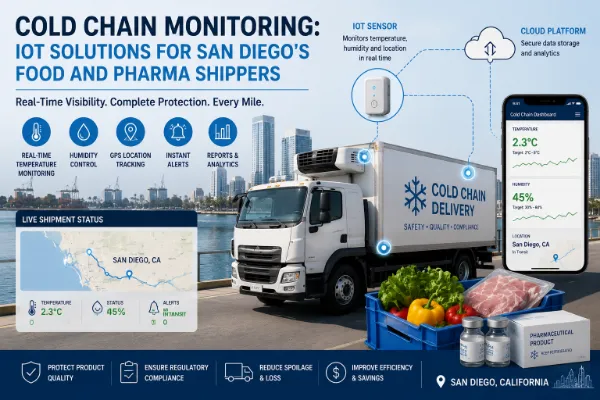
- Cold chain temperature and humidity sensors logging continuous readings throughout transit, critical for the produce and pharmaceutical loads that make up a substantial share of cross-border volume through San Diego.
- Geofenced alerting that flags when a shipment deviates from its expected route or sits stationary longer than historical patterns would predict, giving dispatchers an early signal to investigate rather than discovering a problem only when a delivery window is missed.
- Electronic logging and documentation integration, syncing cargo condition data directly with customs and compliance documentation to reduce delays caused by manual paperwork discrepancies at the crossing.
What makes this different from a standard domestic freight tracking setup is the emphasis on maintaining data continuity through the border handoff itself, historically one of the biggest blind spots in cross-border supply chains.
For freight brokers, trucking companies, and the manufacturers and distributors relying on predictable cross-border delivery, the value of this visibility shows up in a few concrete ways.
- Reduced spoilage and rejected loads. Continuous cold chain monitoring catches a developing temperature excursion early enough to intervene, rather than discovering a compromised load only at the delivery dock. Given that a meaningful share of global food loss is tied directly to poor temperature control during transit, this has real financial weight for San Diego's produce and perishables importers.
- Better dwell time management. Real-time visibility into where a shipment actually sits in the border queue allows dispatchers to make informed decisions about driver scheduling and downstream delivery commitments, rather than building in excessive buffer time that erodes efficiency across the fleet.
- Reduced cargo theft and loss. Continuous tracking, particularly through the trailer or load switches common at cross-border handoffs, closes a visibility gap that has historically made cargo theft easier to execute undetected.
- Improved customer trust and contract terms. Shippers and receiving customers increasingly expect documented, real-time visibility as a condition of doing business, and logistics operators who can provide it are better positioned competitively than those relying on manual check calls.
- Start with your highest-value or most sensitive cargo category. For most San Diego cross-border operators, that means temperature-sensitive produce or pharmaceutical loads, where the cost of a failed shipment justifies the sensor investment fastest.
- Deploy trailer-level tracking before item-level tracking. Trailer or container-level GPS and condition sensors deliver the bulk of the visibility value at a fraction of the cost of instrumenting individual pallets or cases.
- Integrate tracking data with dispatch and customer-facing systems. Visibility data that lives in a separate app nobody checks doesn't improve outcomes. It needs to flow into the systems dispatchers and customer service teams already use daily.
- Build historical dwell-time baselines specific to your crossing. Otay Mesa and San Ysidro have different traffic patterns, and generic industry benchmarks won't reflect the actual wait time variability your loads experience.
- Expand to broader fleet and cargo coverage once the initial deployment has demonstrated measurable reductions in spoilage, theft, or delivery variance.
Cross-border connectivity and roaming. Trackers and sensors moving between US and Mexican cellular networks need to handle the handoff seamlessly, and not every consumer-grade tracking device is built for reliable cross-border roaming. Choosing hardware designed specifically for international freight operations avoids data gaps at exactly the point in transit when visibility matters most.
Fragmented systems across multiple carriers. Cross-border shipments frequently involve different trucking companies on each side of the border, and if each carrier uses a different tracking platform, maintaining continuous visibility requires integration work that many smaller operators underestimate.
Data volume and alert fatigue. Continuous sensor data across a large fleet can quickly overwhelm dispatchers if the system isn't configured to surface only meaningful exceptions. Effective deployments prioritize exception-based alerting over raw data dashboards nobody has time to monitor continuously.
Documentation and compliance integration. Cross-border freight already carries substantial customs and compliance documentation requirements, and IoT tracking data delivers the most value when it's integrated with that documentation rather than existing as a separate system, reducing the manual reconciliation work that slows down clearance.
The next phase for San Diego's cross-border logistics sector centers on tighter integration between IoT tracking data and automated compliance screening. AI-enabled trade compliance tools are increasingly capable of processing the fragmented, unstructured documentation that has historically slowed cross-border clearance, and pairing that capability with real-time cargo condition and location data creates a more complete, automated picture of a shipment's status from origin to final delivery. Unified intelligence platforms that bring location data, compliance screening, and dispatch together, rather than requiring logistics teams to check several disconnected systems, are becoming the standard that competitive operators are moving toward.
For a corridor as economically significant as San Diego and Tijuana's cross-border freight network, the operators building this connected visibility now are positioning themselves to handle the friction and unpredictability inherent to border logistics far more reliably than those still relying on phone calls and manual check-ins.
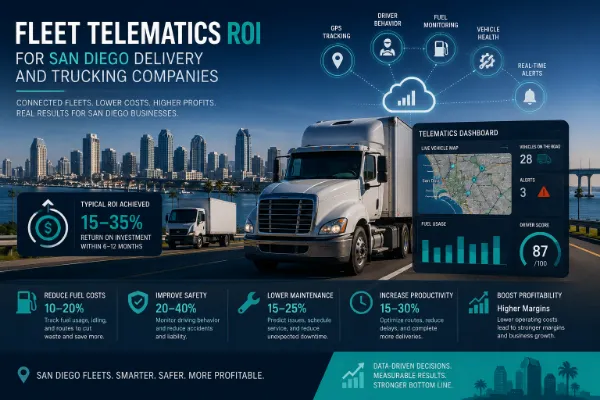
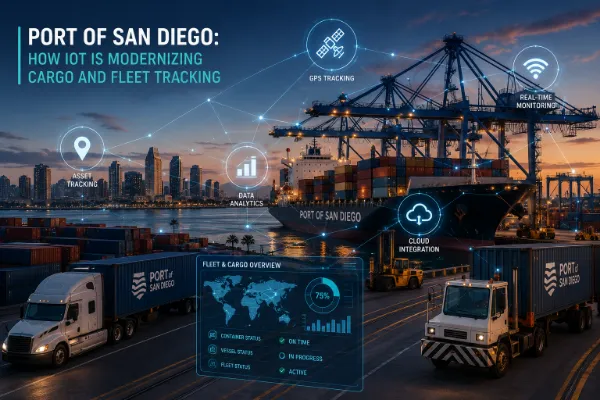
For related coverage, see our detailed look at IoT cargo and fleet tracking at the Port of San Diego, our guide to cold chain monitoring for San Diego food and pharma shippers, and our breakdown of fleet telematics ROI for San Diego delivery and trucking operations. San Diego-based Netradyne is among the local companies active in connected fleet safety technology. Explore more coverage in our Logistics & Transportation category or the San Diego logistics and transportation hub.
Frequently asked questions
Results depend heavily on the specific commodity and prior handling practices, but continuous cold chain monitoring that catches temperature excursions early, rather than discovering them at delivery, commonly prevents losses that would otherwise result in rejected or discounted loads. The value is highest for high-margin, highly perishable products where even a short temperature deviation can render a shipment unsellable.
IoT tracking doesn't directly influence customs processing speed, which is controlled by federal agencies, but it does allow dispatchers to make better-informed decisions around driver scheduling and delivery commitments by providing accurate, real-time visibility into where a shipment actually is in the crossing process.
Smaller operators increasingly have access to affordable, subscription-based tracking hardware and software that doesn't require the capital investment large fleets historically needed. Many smaller cross-border freight operators start with tracking on their highest-value loads rather than instrumenting an entire fleet at once.
This handoff point is historically one of the biggest visibility gaps in cross-border logistics. Solutions vary, from cargo-level sensors that move with the freight itself regardless of trailer changes, to integrated data-sharing agreements between carriers on each side of the border that maintain a continuous tracking record.
Devices need to support seamless roaming between US and Mexican cellular networks to avoid data gaps during the border crossing itself. Hardware designed specifically for international freight operations generally handles this transition more reliably than consumer-grade or domestic-only tracking devices.
Yes, when integrated properly. Continuous condition and location data can support and corroborate the documentation required for customs clearance, and some platforms now integrate directly with trade compliance screening tools, reducing the manual reconciliation work that has traditionally slowed cross-border processing.
Related articles

 Logistics & Transportation