Ask any avocado or citrus grower in Valley Center, Pauma Valley, Ramona, or Fallbrook what keeps them up at night, and the answer is rarely pests or frost. It's the water bill. San Diego County imports the vast majority of its water through the San Diego County Water Authority, and agricultural rates track some of the highest in the state. For a 20 to 40 acre grove, a bad irrigation decision doesn't just cost yield, it costs thousands of dollars a month. That single fact is why San Diego's backcountry has quietly become one of the more interesting test beds in the country for a new category of farm technology: AIoT, or artificial intelligence running directly on the sensor itself, paired with satellite and long-range wireless connectivity built for places cell towers don't reach.
This isn't the generic "smart farming" pitch you'll find in a national trade publication. San Diego's growing conditions are specific: steep, canyon-cut terrain, microclimates that shift dramatically within a quarter mile, and water that is both scarce and expensive. The technology that works here looks different from what gets deployed across flat Midwest cornfields, and the businesses adopting it are making very different calculations.
Most agricultural IoT case studies come from large, flat operations where a single weather station and a handful of soil probes can represent hundreds of acres. San Diego County agriculture doesn't work that way. A single avocado ranch in the hills above Valley Center might have three or four distinct microclimates on one property, with south-facing slopes drying out twice as fast as shaded canyons. Citrus groves near Ramona deal with temperature swings that can trigger frost protection needs on the same night that a nearby coastal grove in Fallbrook stays comfortably above freezing.
The connectivity problem compounds this. Large swaths of San Diego's backcountry sit in cellular dead zones. Growers who have tried consumer-grade "smart" irrigation controllers often find them useless once they're more than a few hundred feet from a router. This is where the current wave of agricultural IoT genuinely differs from what existed even three years ago.
The term gets thrown around loosely, so it's worth being precise. AIoT refers to running inference, the actual decision-making, directly on or near the sensor rather than shipping raw data to a cloud server and waiting for a response. For a grower, that translates into a few concrete capabilities:
- Multi-parameter soil arrays that track moisture at several depths simultaneously, since avocado roots and citrus roots draw water from different soil layers.
- On-device anomaly flagging, so a sensor cluster can alert a grower to a developing problem such as a cracked drip line or an emitter clog within hours instead of days.
- Microclimate-specific irrigation scheduling that adjusts zone by zone rather than applying one blanket schedule across an entire property.
- Canopy and stress detection using low-cost multispectral or thermal sensors that catch water stress before visible wilting appears.
The shift toward edge processing matters specifically because of San Diego's connectivity gaps. A sensor that can make a basic irrigation decision locally, and only phone home when it truly needs to, keeps working even when the backhaul link to the cloud is spotty.
The most practical development for San Diego agriculture isn't the AI model itself, it's the connectivity layer underneath it. Growers are increasingly deploying a hybrid approach that combines low-power, long-range wireless networks such as LoRaWAN for in-field sensor mesh with satellite backhaul for the final hop to the internet. This matters enormously for hillside properties in East County and North County backcountry areas where running fiber or relying on cellular data was never realistic.
A typical setup looks like this: dozens of low-cost soil and microclimate sensors communicate over a LoRaWAN mesh network that can span a mile or more without a cell signal. That mesh routes back to a single gateway, which then uses a satellite or fixed wireless link to reach the grower's dashboard. The result is a system that costs a fraction of what a fully cellular-connected deployment would run, and it actually works on the terrain San Diego growers are dealing with.
For San Diego growers, the return on investment case is almost entirely about water. Because agricultural water in the county is imported and priced accordingly, even a modest reduction in over-irrigation has an outsized financial impact compared to regions with cheaper, locally sourced water. Growers who have piloted precision irrigation report water savings commonly cited in the 20 to 30 percent range industry-wide, though actual results vary by crop, soil type, and how poorly the previous schedule was calibrated.
Beyond the water bill itself, there are secondary business benefits that matter for a working ranch:
- Reduced labor spent manually checking soil moisture and walking irrigation lines.
- Fewer emergency service calls for irrigation failures caught early instead of after a section of trees has already stressed.
- Better documentation for water-use reporting, which increasingly matters as local water agencies tighten agricultural allocation rules during drought years.
- Improved crop consistency, which matters for growers selling into premium markets where fruit size and quality carry a price premium.
None of this requires ripping out an existing drip irrigation system. Most sensor platforms are designed to layer on top of whatever infrastructure is already in the ground, feeding data into the existing irrigation controller rather than replacing it.
Growers who adopt this technology successfully tend to follow a similar sequence rather than trying to instrument an entire property at once.
- Start with the driest or highest-value block. Instrument a single problem zone, such as a south-facing hillside or a block with a history of stress, rather than the whole property.
- Establish a water-use baseline. Run the sensors alongside the existing irrigation schedule for a few weeks before making any changes, so there's a clear before-and-after comparison.
- Adjust one variable at a time. Change irrigation timing or duration based on sensor data, then measure the effect before layering on additional automation.
- Expand to canopy or microclimate sensors once the soil moisture data has proven reliable and the grower trusts the system.
- Automate gradually. Move from sensor-informed manual adjustments to semi-automated valve control only after a full growing season of confidence in the data.
This phased approach protects a grower's cash flow and avoids the common failure mode of installing an expensive, fully automated system before anyone on the property fully trusts what the sensors are telling them.
The technology isn't plug and play, and it's worth being honest about where growers get stuck.
Digital literacy and time. Many multi-generation growing operations don't have staff whose job is to interpret dashboards. The platforms that succeed in San Diego tend to be the ones that translate raw sensor data into plain-language recommendations rather than requiring a grower to become a data analyst.
Upfront cost relative to margin. Avocado and citrus margins fluctuate with commodity pricing, and a system that looks affordable in a good year can feel like a stretch in a lean one. Growers who succeed tend to finance the initial deployment against documented water savings rather than treating it as a discretionary technology purchase.
Sensor placement and calibration. Soil sensors placed incorrectly, too shallow, too close to an emitter, or in a spot that doesn't represent the block, generate misleading data that can do more harm than having no sensors at all. This is the single most common reason a pilot fails to show results.
Interoperability. Growers who buy sensors from one vendor and irrigation controllers from another sometimes discover the two systems don't talk to each other cleanly. Asking about open standards and export formats before purchasing avoids this trap.
The next phase of agricultural IoT in San Diego County is likely to center on three developments. First, insurers and water agencies are beginning to explore bundling risk mitigation with connected monitoring, effectively rewarding growers who can document responsible water use with better rates or priority allocation during restrictions. Second, computer vision paired with drone or fixed-camera imagery is becoming affordable enough for mid-size operations, not just large commercial farms, to spot pest pressure and disease before it spreads. Third, open interoperability standards are starting to mature, which should reduce the vendor lock-in problem that has frustrated early adopters.
For San Diego's growers, the underlying pressure isn't going away. Water costs are structurally high and likely to stay that way, and the county's mix of hillside terrain and connectivity gaps means off-the-shelf solutions built for other regions rarely work as advertised. The growers seeing the best results are the ones treating this as an incremental investment in water efficiency rather than a wholesale technology overhaul, starting small, measuring carefully, and expanding only once the data has earned their trust.
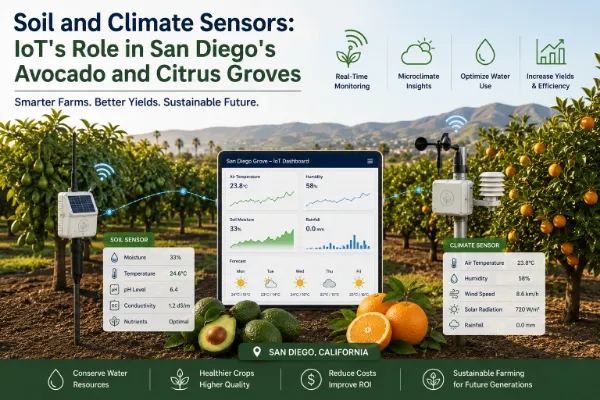
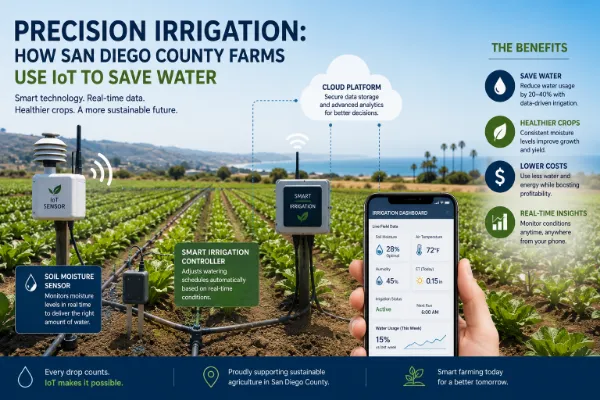
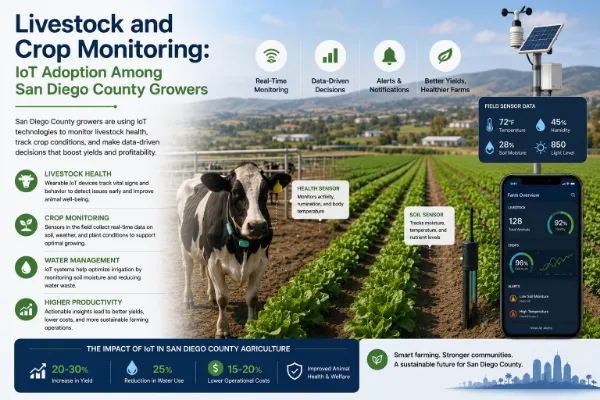
For a closer look at irrigation-specific deployments, see our guide to precision irrigation for San Diego County farms, and our breakdown of soil and climate sensor options for avocado and citrus groves. Growers managing mixed operations may also want to review how livestock and crop monitoring IoT is being used across San Diego County. Explore more coverage in our Agriculture IoT category or browse the full San Diego agriculture IoT hub.
Frequently asked questions
Results vary by property, but growers piloting precision soil and microclimate sensors commonly report water savings in the 20 to 30 percent range compared to fixed, calendar-based irrigation schedules. Because San Diego's imported agricultural water is priced higher than in most other California growing regions, even modest percentage savings translate into meaningful dollar amounts.
Cellular coverage is unreliable across much of North and East County's growing areas, so most successful deployments use a low-power wide-area network such as LoRaWAN for the in-field sensor mesh, combined with a satellite or fixed wireless link for backhaul to the internet. This hybrid approach avoids the dead zones that make consumer-grade smart irrigation controllers unreliable on hillside properties.
Sensor hardware costs have dropped significantly, and most growers start with a handful of sensors on a single high-value or problem block rather than instrumenting an entire property. Financing the pilot against documented water savings, rather than treating it as a separate capital expense, is the most common path smaller operations use to get started.
Yes. Avocado root systems are shallower and more sensitive to both over-watering and drought stress, while citrus tolerates a wider moisture range but responds strongly to temperature swings. Sensor placement and the depth at which moisture is measured should be configured differently for each crop, which is why generic, one-size-fits-all systems often underperform.
Many San Diego growers report recovering their initial sensor investment within one to two irrigation seasons, largely driven by water savings and reduced labor spent manually checking soil conditions. Payback timelines shorten considerably on blocks that were previously over-irrigated out of caution.
In most cases, no. Modern sensor platforms are designed to integrate with existing drip irrigation infrastructure and controllers, feeding data into the current system rather than requiring a full replacement. Full automation of valves is typically an optional later step, not a requirement to get started.
Related articles

 Agriculture IoT